Most of the American age-verification debate for the last three years has been an argument about a number. What fraction of a platform’s content has to be “harmful to minors” before the platform has to check IDs at the door? Texas answered one-third. The Supreme Court blessed that framing in Free Speech Coalition v. Paxton in June 2025. Missouri copied the test into hard law in July 2026. And for every general-audience operator — a forum, a marketplace, a streaming catalog, a social feed, an AI product — that ratio was the escape hatch. You measured your own content mix, found you were nowhere near the line, and moved on.
The federal SCREEN Act removes the number. Read the text and there is no “significant portion” requirement, no one-third test, no ratio to hide behind. A service that hosts even a single piece of qualifying content can fall inside the mandate. On August 5, 2026, the bill cleared a Senate Commerce Committee vote 15–13 and then failed to advance because the room lost quorum — a stumble, not a defeat, and a signal that a federal age-verification floor is now a question of when the votes are in the room, not whether the idea has support. The scoping logic the bill encodes is the part general-audience teams have not costed. This is that cost.
What actually moved on August 5 — and what didn’t
The SCREEN Act — the Shielding Children’s Retinas from Egregious Exposure on the Net Act, S.737 in the Senate with a House companion in H.R.1623 — is sponsored by Sen. Mike Lee (R-Utah). On August 5, 2026 the Senate Commerce Committee took it up in the same markup that advanced the Kids Online Safety Act, voted 15–13 to move it, and then could not report it out because too few senators remained present to satisfy quorum. It is still a bill, not a law. It has not passed the Senate, and it has been reintroduced across Congresses before without enactment.
Treat that history as a reason to prepare, not a reason to wait. The prudent posture for a compliance or platform team is the one the ComplianceHub analysts framed well: read the bill “less as a prediction and more as a specification.” It describes, with unusual clarity, where federal age-verification obligations are heading — and most of what it demands is already demanded, in fragments, by the state patchwork you are probably already tracking. The bill is not the risk. The bill is a clean description of the risk you already carry.
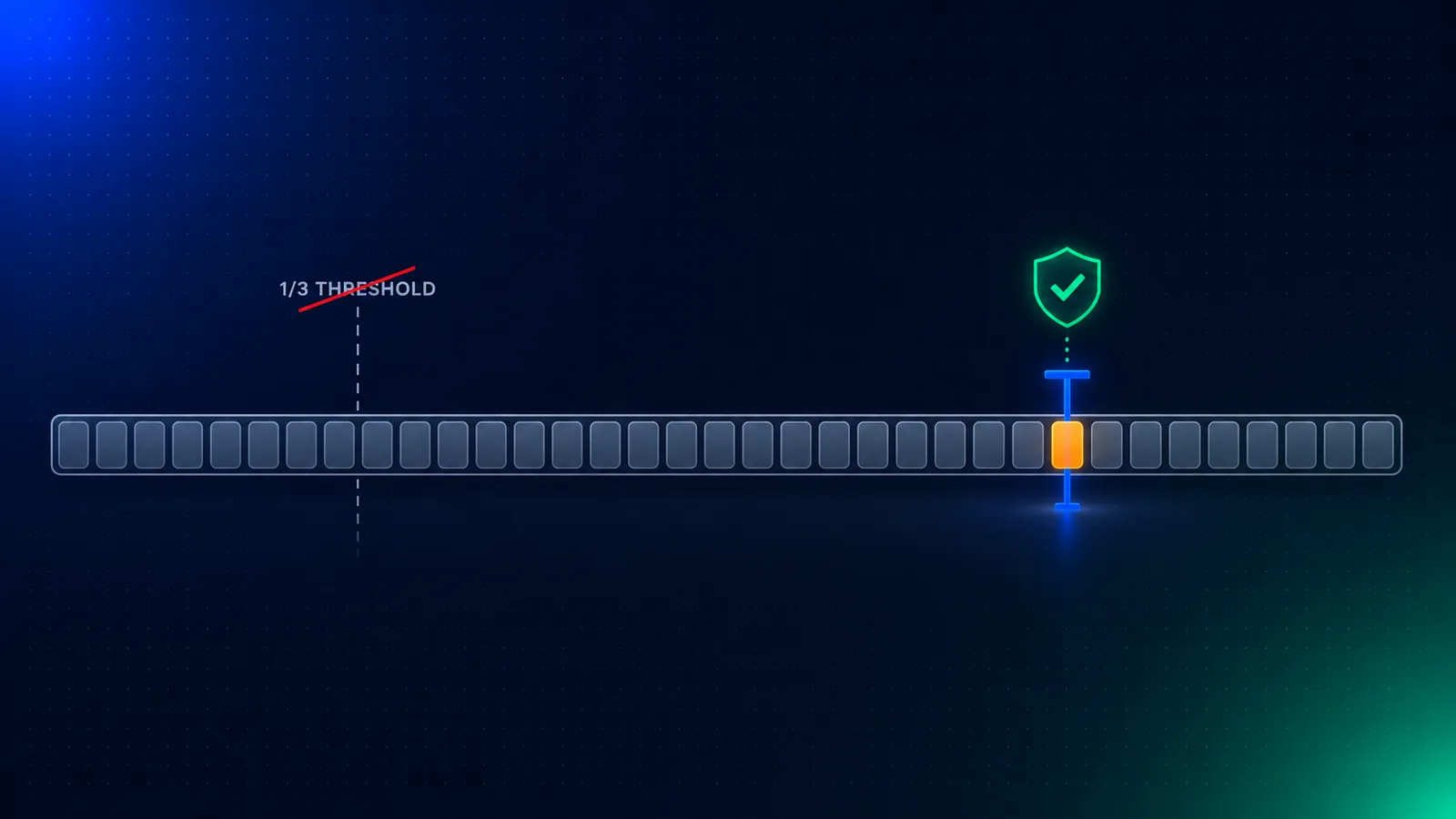
The threshold was the escape hatch. SCREEN takes it away.
Here is the structural change, stated plainly. Under the state regime, coverage is a property of your content mix. Texas’s HB 1181 applies when at least one-third of a site’s material is harmful to minors; Missouri wrote the same ratio into law. We made the case in July that the ratio, not the label, is what decides your compliance surface — that “we are a general-audience platform, not an adult site” is not a defense, because the statute measures what you host, not what you call yourself.
The SCREEN Act pushes that logic one step further and then removes the last handhold. As the Electronic Frontier Foundation reads the text, the bill “has no requirement that a significant portion of the website consist of sexually explicit content that is harmful to minors.” One qualifying item is enough to bring the service inside the mandate. That is why critics list Netflix, Reddit, Discord, and Bluesky alongside the obvious adult sites: a streaming service with a single mature title, a forum with one explicit thread, a social network with adult content anywhere in its firehose. The category never protected you; now the ratio doesn’t either.
For a general-audience platform, this inverts the scoping question. The old question was quantitative and survivable: how much of what we host crosses the line? You could answer it with a content audit and usually breathe out. The new question is binary and much harder to answer “no” to at scale: do we host any of it, anywhere, including in user-generated content we didn’t publish and can’t fully see? If your platform accepts uploads, runs a feed, or hosts a catalog of any size, the honest answer under a no-threshold rule trends toward “assume yes.”
Four demands that reshape the build
The bill is narrow in subject matter and broad in technical demand. Four provisions matter most for how you architect, not just whether you comply.
Self-attestation is banned outright. The single most consequential line in the bill prohibits relying on a user clicking a button to assert they are over 18. The entire legacy pattern — “I am 18 or older, Enter” — is non-compliant on its face. This is not new to anyone who has read the state laws or the FTC’s 2026 COPPA enforcement posture, which rewards accurate, data-minimal age assurance over checkboxes. SCREEN would make it federal and universal for covered content.
You have to publish your method. Covered platforms must disclose the verification process they use. Your age-assurance design becomes a public, auditable artifact — which means it has to withstand scrutiny from regulators, plaintiffs, and journalists, not just satisfy an internal review.
VPN and proxy traffic is explicitly in the net. Every time a state age-verification law takes effect, VPN sign-ups spike in that state; it is the best-documented circumvention pattern in the category. SCREEN answers it directly: platforms must subject users’ IP addresses — including known VPN and proxy addresses — to the verification measures, unless the platform determines the user is outside the United States. A design that quietly waves through VPN traffic is a design that fails the statute.
Data security and minimization are statutory, not optional. The bill acknowledges age verification’s central paradox in its own text: to keep minors out, you must collect identity signals from every adult who has a lawful right to the content, and every such system becomes a repository of exactly the data breaches are made of. SCREEN requires strong security and minimized retention. Enforcement sits with the FTC, which can audit, issue guidance, and treat violations through its unfair-or-deceptive-practices machinery — a familiar architecture with real teeth.
Why walling the whole front door is the wrong answer
The no-threshold trigger creates a specific and dangerous temptation. If a single item anywhere on your platform can bring the whole service into scope, the fastest-looking fix is to age-gate the entire product at the front door — verify everyone, everywhere, before they see anything. Do not do this. It is the worst available response on every axis that matters.
It destroys the funnel. A hard identity gate in front of your entire product is an abandonment cliff; you would be applying adult-site friction to the ninety-plus percent of sessions that never touch the qualifying content. It builds the honeypot. Verifying every user at the door means collecting and holding identity data on your whole population — the exact concentration of sensitive data that the bill’s own minimization clause, and every breach in this category, tells you to avoid. And it worsens your constitutional position, not improves it. Age-verification mandates on lawful adult speech are judged against a narrow-tailoring standard; a platform that gates all content, including material that isn’t harmful to minors, is by definition less narrowly tailored than one that gates only what the law reaches. The over-broad gate is both a privacy liability and a litigation liability.
The correct move is the opposite of a bigger wall. It is a smaller, smarter one.
The architecture: scope the gate to the content, not the site
The design that answers a no-threshold mandate without nuking your product has four parts. It is the same two-tier model we build Xident around, applied to a scoping problem instead of a volume one.
Trigger at the content, not the perimeter. Age assurance fires at the point where a user requests the qualifying item — the mature title, the explicit thread, the adult listing — not on landing. The rest of the product stays open. This keeps the gate narrowly tailored (which is exactly what the First Amendment analysis wants), keeps friction off the sessions that don’t need it, and shrinks the population you ever collect anything from down to the users who actually reach regulated content. A single qualifying item pulling you into scope does not have to mean a single item gating your entire audience.
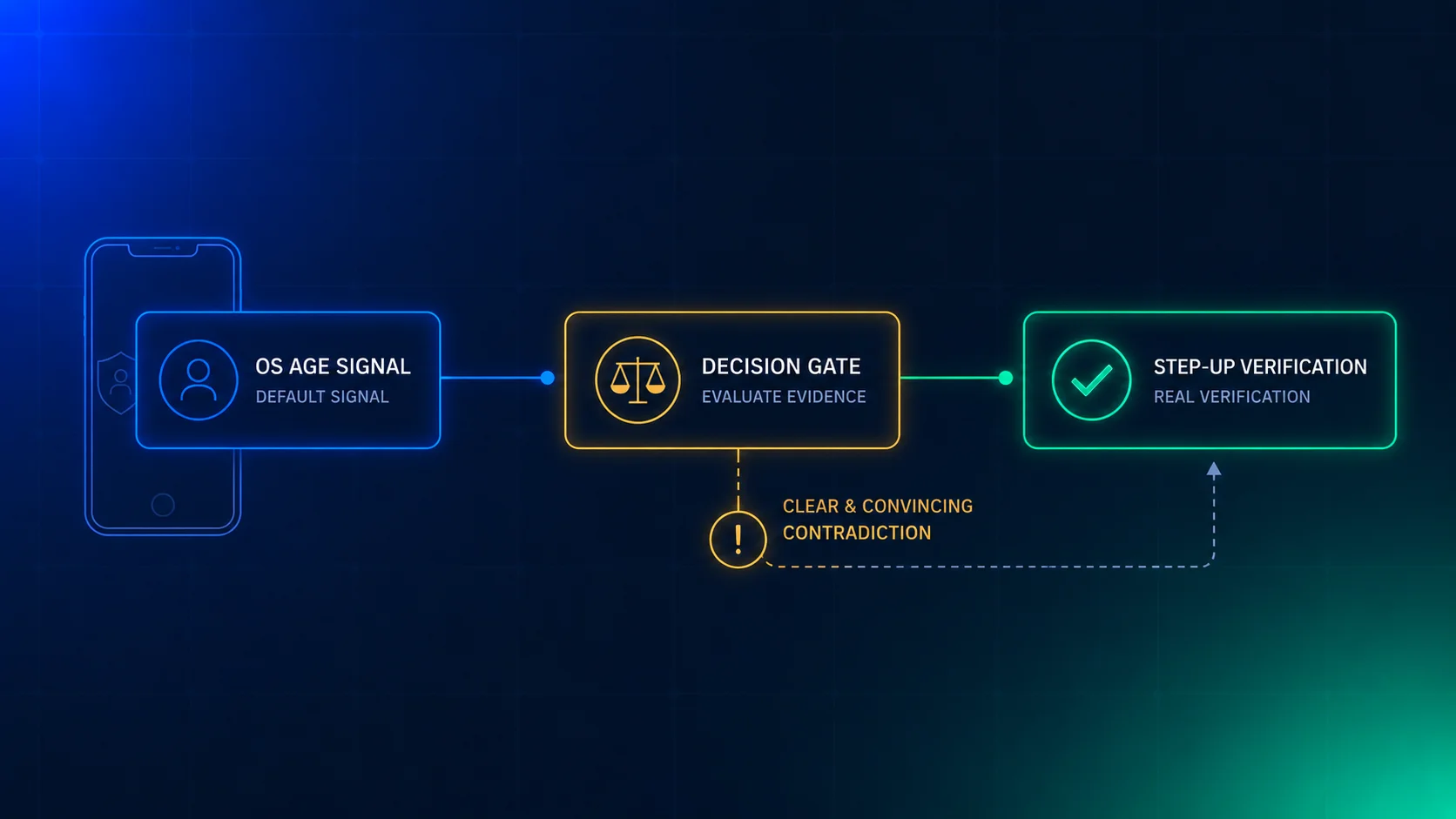
Two tiers, so most users never hit the hard path. Resolve the easy majority with a low-friction Check: a returning user who already holds a verified credential, an authenticated device handoff, or a privacy-preserving age estimation that clears the confident-adult cases and satisfies the bill’s requirement for at least one path that does not demand a government ID. Reserve a full Verification — a chip-read document or a mobile driver’s license with selective disclosure — for the contested minority the Check can’t resolve. Most users clear the cheap tier; the expensive, high-assurance path is spent only where it’s needed.
Retain the assertion, not the evidence. The output your systems store is a signed “this user is over 18,” not the ID image or the face scan behind it. This is the direct answer to the bill’s minimization mandate and the single most effective thing you can do to make the inevitable breach boring instead of catastrophic. A stolen database of “verified: 18+” tokens is not the same headline as a stolen database of government IDs mapped to the content people viewed.
Make VPN a signal, not a wall. The statute wants VPN and proxy traffic run through verification, not blocked. Treat a known VPN or proxy IP as a reason to step up assurance for that session — escalate from Check to Verification — rather than to deny access to a legitimate adult using a VPN for ordinary privacy reasons. That satisfies the letter of the requirement while keeping you off the wrong side of the anonymity debate the bill’s critics are already having.
Layer a reusable credential across all of this and the economics change again: a user who verifies once at one qualifying gate can prove “over 18” at the next one — on your platform or another — without re-uploading anything. Verify once, prove everywhere. That is what turns a per-item friction tax into a one-time cost the user pays a single time.
What to do before it is law
Because the state patchwork already demands most of this, the work does not depend on the SCREEN Act passing. Six moves are defensible today and directly on the bill’s trajectory:
- Retire self-attestation as a primary control. The “click to confirm” gate is already non-compliant under multiple state laws and would be explicitly barred federally. Plan its replacement now, before an enforcement letter sets the timeline for you.
- Choose a data-minimizing architecture. Favor methods that return a binary age signal and discard the underlying identity data over anything that stores ID scans. This serves the minimization mandate and cuts your breach exposure in the same stroke.
- Design VPN and proxy handling deliberately. Decide, as an explicit policy, how your geolocation and IP-classification stack escalates assurance for VPN and proxy sessions. Do not leave it as an accident of your CDN configuration.
- Write the public description of your method. Transparency is a SCREEN requirement and increasingly a state one. Draft the plain-language description of how you verify age now; a method you can’t explain in public is a method you should reconsider.
- Lock down the verification pipeline. Treat any identity data collected during verification as your most sensitive holding: encrypt it, minimize retention, restrict access, and assume it is the first thing a regulator or plaintiff asks about after an incident.
- Map the federal-state interaction. SCREEN as drafted is a floor, not a preemption of state law. Assume you must satisfy both the federal mandate and the stricter or differently-scoped state rules simultaneously, and build one verification flow that clears the highest bar among them.
The real headline
Another federal age-verification bill advancing is not, by itself, news; the category has produced a steady stream of them. The news is what the text does to scoping. State law handed general-audience platforms a threshold — a ratio you could measure and usually clear. The SCREEN Act deletes the threshold and replaces it with a single-item trigger, bans the checkbox, pulls VPN traffic into the net, and hands the FTC the enforcement pen. The platforms that read that as “we need a bigger wall” will build an abandonment cliff and a honeypot and hand a plaintiff a narrow-tailoring argument. The platforms that read it as “we need a narrower, smarter gate” will scope assurance to the content, resolve most users with a cheap Check, reserve high-assurance Verification for the contested few, and keep the assertion instead of the ID.
The threshold was the thing you measured. Now it’s gone, and what’s left is architecture. Build the gate that fits the content — not the one that fits your fear.
Xident provides privacy-first age assurance built on a two-tier model: a low-friction Check for the confident majority and a high-assurance Verification for the contested few, returning a signed age assertion rather than retaining the underlying identity document. If you run a general-audience platform and want to scope a gate to specific content rather than your whole front door, see how the two operations work or talk to us.