The sweepstakes model was designed to defer the awkward questions. Play with a free entertainment currency, collect a second “promotional” currency you can redeem for prizes, and the legal argument writes itself: it is a sweepstakes, not gambling, because there is always a no-purchase path to the redeemable coin. That framing let the whole category grow from roughly $3.1 billion in 2022 to about $11 billion in 2025 (Sumsub) while treating identity as a cash-out formality. Age was a checkbox at signup. Real verification waited until a player asked to be paid.
In 2026 that architecture stopped surviving contact with regulators. The deferral was always structural, not just operational, and once a dozen states decided the dual-currency coin looked enough like gambling to legislate against it, “we verify at payout” went from clever to indefensible. If you operate a sweepstakes or social casino, the age and identity check just moved from the exit to the front door, and the reasons are worth understanding before you rebuild the flow.
What the model was built to avoid
The redemption-trigger model is elegant precisely because it does so little up front. A player registers with an email and a self-attested date of birth, receives a pile of the entertainment currency, and starts playing. Nothing about who they are, how old they actually are, or where they are sitting gets tested. Only when they try to convert the redeemable currency into cash does the platform request a government ID, a proof of address, and sometimes a selfie (Sumsub). The minimum age is usually 18, occasionally 21 to match real-money norms, but the number barely matters when the only thing standing behind it at registration is a form field the user typed themselves.
The appeal is obvious. Onboarding friction is the single largest tax on conversion in any consumer product, and the sweepstakes pitch depends on getting a new player into a game in seconds. Deferring verification to the small fraction of users who ever request a payout kept that funnel wide. It also meant the platform was flying blind on everyone else, which is the flaw that 2026 exposed.
2026 was the year the deferral stopped working
The legal picture changed faster than most operators’ compliance roadmaps. At least a dozen states have now banned or restricted dual-currency sweepstakes platforms, and the 2026 cohort alone — California, Indiana, Maine, New York, Louisiana, and Tennessee — passed laws aimed squarely at the virtual-currency loophole (Bright Side of News).
California’s AB 831 is the one to read closely, because it does more than ban. Signed by Governor Newsom on October 11, 2025 and effective January 1, 2026, it prohibits operating or supporting online dual-currency sweepstakes games in the state, with violations carrying penalties up to $25,000 each. The clause that should reshape your vendor diligence: liability extends to the vendors and partners — geolocation providers, payment processors, content suppliers, media affiliates — who knowingly support these platforms (Zwillgen, rg.org). The bill passed 36-0 in the Senate and 63-0 in the Assembly, so this is not a partisan skirmish that flips with the next election.
New York went further on the criminal side, making it a felony to promote or operate sweepstakes platforms targeting its residents, after Attorney General Letitia James sent cease-and-desist letters to 26 operators in 2025, all of which agreed to stop selling Sweeps Coins in the state (Bright Side of News). Tennessee, in May 2026, routed enforcement through its Consumer Protection Act and handed expanded powers to its attorney general. Indiana took the one constructive path in the group, banning the unlicensed model but opening a route for operators to apply for state iGaming licenses.
Two things follow from this map. First, if you serve players nationally, your registration logic is now defined by the strictest states you touch, the same dynamic we described for the broader US compliance patchwork. Second, and specific to this vertical, AB 831 means your choice of verification vendor is itself part of your liability surface. A provider that quietly retains identity data, or that cannot demonstrate a defensible age and eligibility decision, is no longer just an integration risk. In the states drawing the line, it is a co-defendant risk.
The three questions operators keep collapsing into one
Most sweepstakes stacks treat verification as a single event: at payout, prove the player is real. That collapses three distinct questions that have different answers, different costs, and — critically — different correct timing.
The first question is age. Is this player old enough to be here at all, 18 or 21 depending on your policy and jurisdiction? This is binary and it belongs at the door, before any value accrues.
The second is identity. Who is this person, tied to a genuine government document, matched to a real face? This is the expensive question, and it belongs at the moment real value becomes redeemable, not before and not long after.
The third is eligibility, which is mostly a location and status question. Is this player sitting in a banned state, on a self-exclusion list, or on a sanctions list? Identity proof does not answer it. A valid passport held by a real 30-year-old in a prohibited state is still an ineligible session (NHI Management Group). Collapsing eligibility into “we checked their ID at cash-out” is how operators end up with paid-out balances they were never allowed to create.
Separating these is not academic. It is what lets you put cheap checks where friction hurts conversion and expensive checks where the money and the regulator’s attention actually are.
Redemption-only verification is a timing failure
The deeper problem with the payout-trigger model is not that its verification is weak. When a payout finally forces a document scan, that scan can be perfectly robust. The problem is when it happens. Between registration and first redemption sits a long, unmonitored stretch — the identity delay window — in which a platform allows account creation, play, bonus accumulation, and multi-account activity before applying its first meaningful control (NHI Management Group).
Everything that goes wrong in this category lives in that window. A minor plays for weeks before anyone tests the birth date they typed. One person spins up ten accounts to farm promotional coins, and the duplication is only discovered when several of them request payouts. A player in a banned state accrues a redeemable balance the operator was never permitted to let them build. By the time the redemption check runs, the control is forensic rather than preventive — it can document the loss, not stop it. Verifying at payout answers “should we pay this person,” which is the wrong question. The right question is “should this account have been allowed to accumulate value at all,” and you can only answer it at the front of the funnel.
What a real stack looks like for this vertical
The fix is not “run full KYC on everyone at signup.” That would nuke the conversion advantage the model depends on and pay for expensive identity checks on players who never deposit or redeem a cent. The fix is to place each check where it belongs.
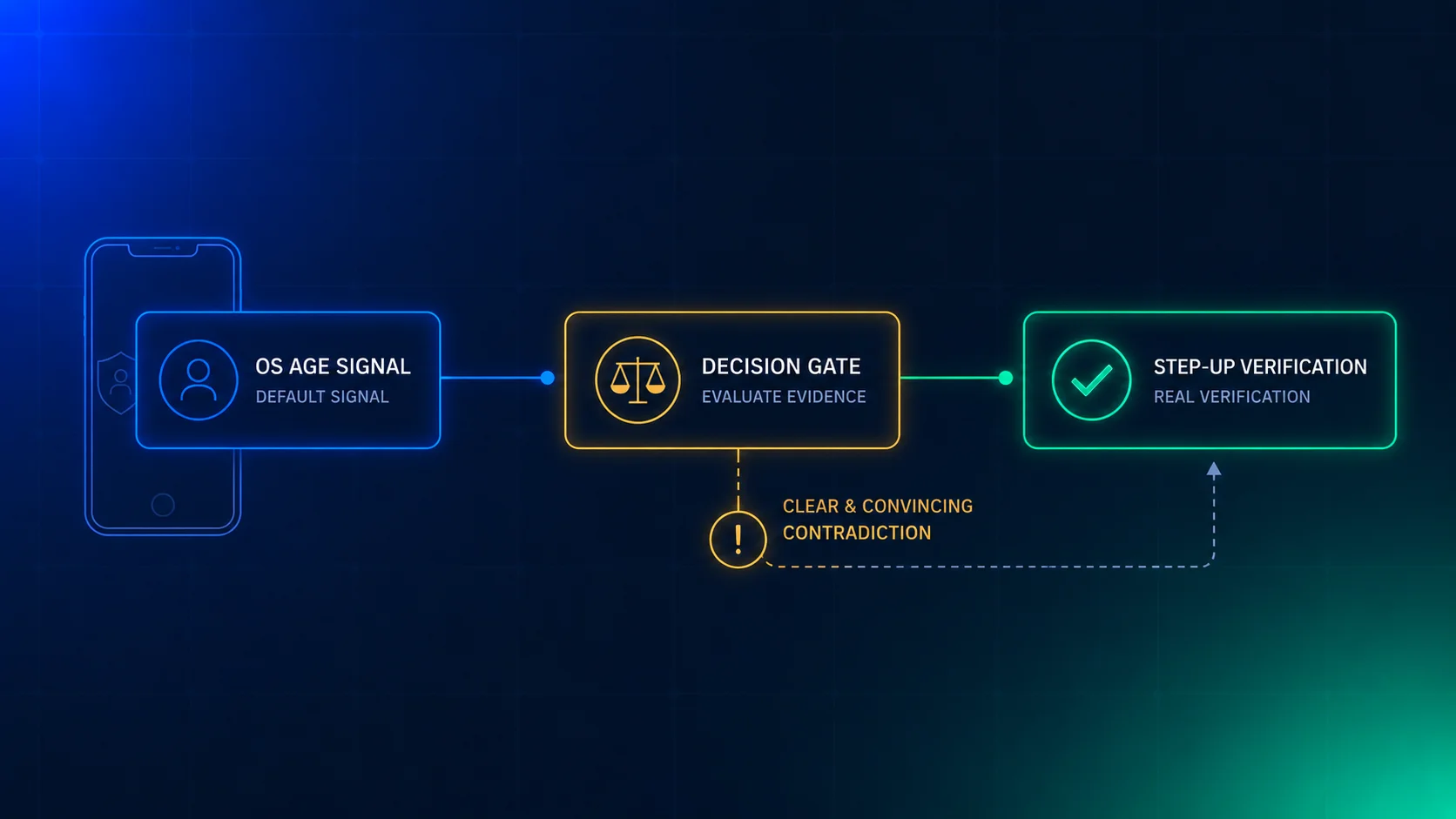
Lead with age at the door as a lightweight Check. A Check is the cheap operation in this stack — a browser-based age signal, a liveness pass, or a returning-player lookup — roughly an order of magnitude less costly than a document scan, and fast enough to sit inside registration without gutting the funnel. For the large majority of players who are comfortably over the age line, that is the entire age story, and no document ever changes hands. It also closes the underage half of the identity delay window immediately, at the exact moment a self-attested birth date used to be the only gate.
Reserve the full document Verification — OCR plus face match against a genuine ID — for the point where value becomes real: first purchase in higher-risk markets, or first redemption at the latest. This is where identity has to be unambiguous, because this is where money and tax and AML obligations attach. Return that identity as structured data your downstream systems can actually use, not a bare pass or fail.
Two engineering choices make the heavy path survivable. First, resist synthetics at the document layer. AI-generated IDs now cost a few dollars and clear a large share of naive upload-and-selfie flows on the first try, a failure mode we detailed in synthetic-ID fraud. An NFC chip read cryptographically signed by the issuing authority, or a mobile driver’s licence, beats a photo of a card a model can fabricate. And do not lean on a successful card charge as a stand-in for age or identity — a card proves an instrument was issued, not that the person holding it is of age, as we argued in why a credit card is not proof of age. Second, do not make loyal players re-verify from scratch. A sweepstakes player who redeems monthly should not repeat a full document scan every time; a reusable, cryptographically bound credential lets a verified player prove age and identity again with a lookup. The cheapest verification is the one you never have to run twice.
The AML and tax layer you inherit at redemption
The moment a promotional coin becomes redeemable for cash, the platform crosses from engagement mechanics into value transfer, and a different body of obligation switches on. Cash redemptions above IRS thresholds carry reporting duties. Larger or patterned payouts raise anti-money-laundering questions — source of funds, structuring across accounts, sanctioned recipients (NHI Management Group). Regulated iGaming operators have carried this weight for years; sweepstakes operators inherited it the day states started treating their coin as a gambling instrument.
This is where age verification and AML screening stop being separate purchases. Because Xident already extracts a verified identity — name, date of birth, nationality — at the document step, it can screen that identity against consolidated sanctions and politically-exposed-persons data in the same operation, returned as one additional field in the result you already read. We built that in this month, self-hosted so the screened name never leaves our infrastructure, with a human reviewing every match rather than a machine auto-rejecting a name collision (sanctions and PEP screening built into every verification). For a vertical where the same payout event triggers identity, tax, and AML questions at once, folding screening into the verification you are already running removes a second vendor from the exact workflow regulators scrutinize most.
The corollary is data discipline. It is tempting, under compliance pressure, to keep everything — every ID image, every selfie, every address — on the theory that more retained evidence is safer. For a platform that is not a licensed bank, the opposite is true, and the breach wave that hit age-verification vendors this year is the proof. Keep the decision and its audit trail: that a player cleared the age and identity check, when, against what class of document, and what the screening returned. That is the record a regulator or an auditor asks for. The raw ID image after the decision resolves is not evidence you need — it is a breach headline you are volunteering to write.
Geolocation is a separate control, and honesty about that matters
One boundary worth stating plainly, because the sweepstakes eligibility problem tempts operators to demand one vendor solve all of it. Age and identity answer who and how old. They do not answer where. Whether a player is physically sitting in a banned state is a geolocation question, handled by a geolocation stack, and it is a hard, adversarial problem in its own right given VPNs and spoofing. Xident verifies age and identity, and screens against sanctions and PEP lists; it does not geolocate your players, and a vendor that claims a single check does all four is selling you a gap. Layer the geolocation control alongside the age-and-identity control, keep their evidence separate, and make each one defensible on its own terms. A regulator reviewing an ineligible payout will ask both “did you know how old they were” and “did you know where they were,” and those are two records, not one.
What to build now, in order
Move the age line to the front door as a lightweight Check, and clear the majority of players who are well over the threshold without a document scan — that alone closes the underage portion of the identity delay window that self-attestation left wide open. Escalate to a full document Verification with face match at first purchase or first redemption, where real value and real obligation attach, and resist synthetic documents there with NFC or an mDL rather than a bare image upload. Fold sanctions and PEP screening into that same verification step so the payout event does not require a second AML vendor. Give returning players a reusable credential so their next redemption is a lookup, not a re-scan. Run geolocation as its own control and keep its evidence separate. And retain the decision and its audit trail, not the underlying ID image, because in this category the data you keep is a liability long before it is an asset.
The sweepstakes model spent a decade proving how much verification it could defer. In 2026 the states answered, and the answer was: not this much, and not this late. The door is where the check belongs now.