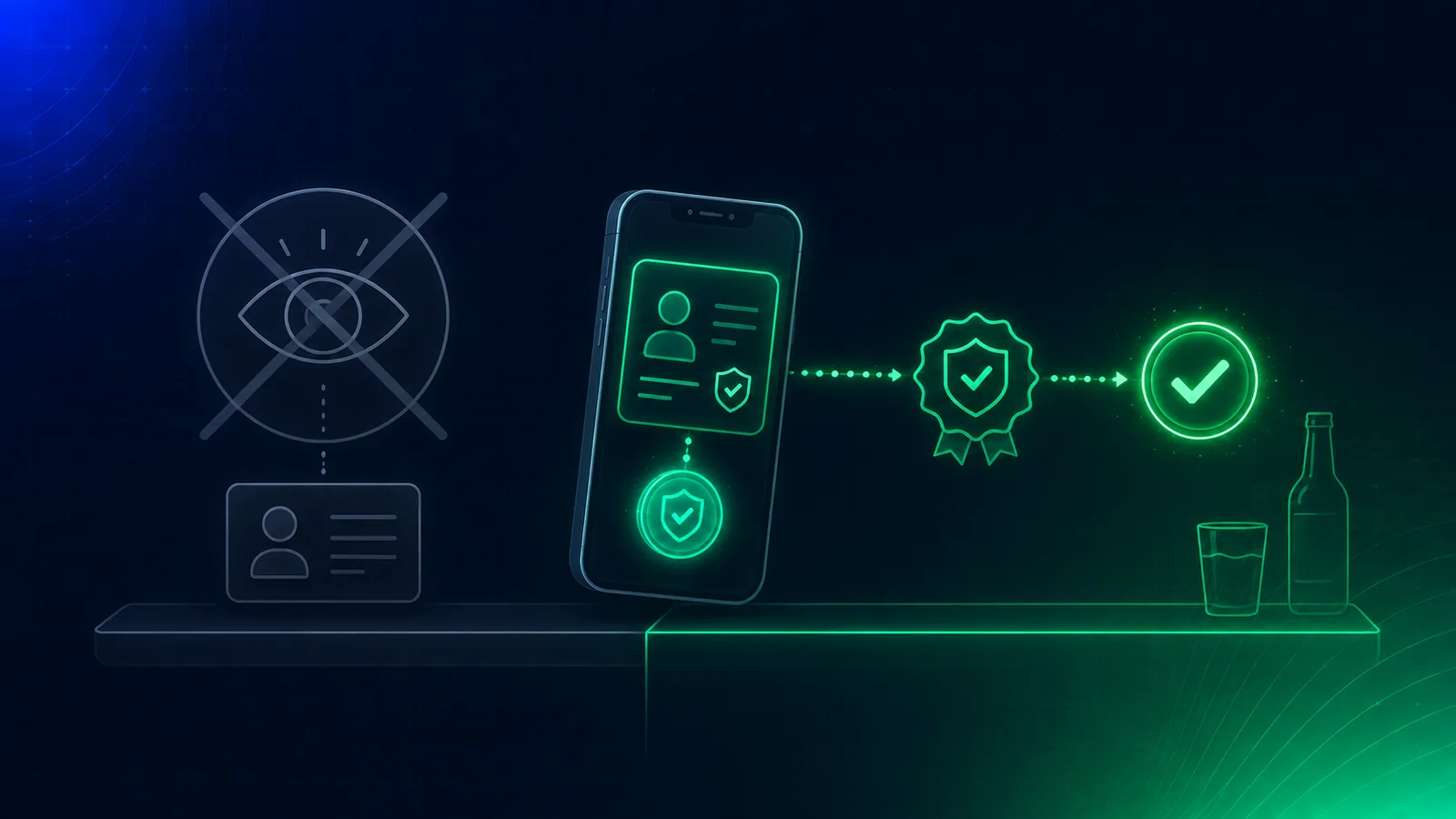
On 30 June 2026, the UK Home Office laid regulations that will let customers in England and Wales prove they are old enough to buy alcohol using a digital check from a registered provider — a phone instead of a passport at the pub, the till, or the club door. Subject to Parliamentary procedure, the change is intended to take effect in autumn 2026, with some coverage pointing to a “by Christmas” arrival.
On the surface this is a convenience story. Nobody enjoys carrying a passport to buy a bottle of wine, and bartenders do not enjoy squinting at holograms. But read the actual regulation and a much bigger shift is visible underneath. The UK is not simply saying “you may now accept a digital ID.” It is defining who is allowed to perform an age check, to what assurance level, and by what means — and it is doing so through a certification-and-register model that turns age verification from a checkbox into regulated infrastructure.
For any operator that gates access by age, online or offline, the pub headline buries the lede. Here is what changed, and why the mechanics matter more than the moment.
What the UK Actually Changed
Today, the Mandatory Licensing Conditions (MLCs) under the Licensing Act 2003 require that any proof of age include a physical security feature — a hologram, an ultraviolet mark, something you can hold up to the light. That requirement, sensible in a paper world, quietly outlawed every digital form of ID. You could hold a government-grade credential in a wallet app and it would not satisfy the condition, because there was no hologram to inspect.
The new statutory instrument removes that barrier. Once in force, licensed premises in England and Wales will be able to rely on digital age verification as an additional option. Three things are worth pulling out of the drafting:
It is additive, not mandatory. Premises are not required to accept digital proof of age, and customers are not required to use it. Physical documents remain valid. Digital verification sits alongside the plastic card rather than replacing it.
It runs through a registered provider. The responsible person meets the condition by being covered by an agreement with a registered Digital Verification Services (DVS) provider — typically arranged by the premises licence holder. This is not “let the customer show you an app.” It is “contract with a provider that the state has certified.”
It sets a floor for assurance and identity binding. The provider must deliver identity verified to a “medium level of confidence,” as defined in the UK DVS trust framework, and must confirm two things: that the customer meets the required age threshold, and that the identity information actually relates to the person presenting it.
That last clause is the one to sit with.
The Line That Should Reshape Your Roadmap
Here is the sentence from the government’s own explanation that matters more than the rest of the regulation combined:
“This validation needs to happen through secure technological means, rather than someone simply looking at a digital proof of age on a screen.”
Read that as an operator, not a pub landlord. The UK has written into law that a visual inspection of a digital credential is not verification. A screenshot of a date of birth is not verification. A photo of a driving licence held up to a webcam is not verification. Flashing a static QR code at a member of staff is not verification. If a human eyeballing a screen is the whole control, the check does not count.
What does count is a cryptographic or technological validation that (a) confirms the credential is genuine and current, and (b) binds it to the person in front of you — the identity relates to the presenter. That is the difference between showing a document and proving a fact. It is the same distinction we have written about when explaining why self-declaration is not enough and why a credit card is not proof of age: a proxy that a determined 15-year-old can borrow, screenshot, or replay is not a control, regardless of how official it looks.
This is not a UK idiosyncrasy. It is the same standard regulators are converging on everywhere — the UK Online Safety Act’s “highly effective” age assurance, France’s ARCOM methodology, the accuracy thresholds in New York’s SAFE for Kids rules. The alcohol regulation just states it in unusually plain language: secure technological means, plus identity binding, or it does not qualify.
Age Verification Is Becoming Regulated Infrastructure
The alcohol rule does not stand on its own. It sits on top of the Data (Use and Access) Act 2025, whose Part 2 digital verification measures came into force on 1 December 2025. That Act is the machinery, and the machinery is the real story.
Part 2 did four structural things:
- It put the UK’s identity trust framework on a statutory footing and renamed it the UK Digital Verification Services (DVS) trust framework, aligning the terminology with the Act.
- It established a statutory DVS register — a public list of providers certified against the framework.
- It created a trust mark. OfDIA, acting for the Secretary of State, designated it “UK CertifID” in March 2026, available only to services certified against the framework and listed on the register.
- It set up conformity assessment as the gate. Version 1.0 of the DVS trust framework comes into force no earlier than 1 September 2026 — specifically, on the date the first conformity assessment body is accredited to certify against it.
Put those together and the shape of the future is clear. The government is no longer content to say “check age.” It is defining who may perform the check (registered, certified providers), to what standard (assurance levels in the framework), verified by whom (accredited conformity assessment bodies), and visible to whom (a public register plus a trust mark). Age and identity verification is being turned into a regulated service with the same certification-and-register scaffolding you would expect around payments or gambling — and the alcohol regulation is simply the first everyday retail use case to plug into it. OfDIA published its first annual report on the operation of these DVS measures on 15 July 2026, underlining that this is now a standing regime, not a pilot.
The parallel abroad is exact in spirit. The EU is building the same certified-credential model through eIDAS 2.0 and the EU Digital Identity Wallet, and Apple and Google are wiring wallet-based credential presentation and mobile driving licences into the operating system. Three of the largest regulatory and platform actors on earth are converging on the same architecture: certified issuers, cryptographic presentation, selective disclosure, and a defined assurance level. The UK alcohol rule is one small, concrete instance of a global pattern.
Why This Is Bigger Than Pubs
Digital IDs are already accepted in the UK for some age-restricted purchases — tobacco, energy drinks, medicines — through approved providers. Alcohol is the next domino, and the government has said outright that it is one of “a growing number of everyday use cases.” That framing is the point. The state is not solving alcohol; it is building a general-purpose rail and lighting up use cases one at a time.
For operators, this collapses a fragmented problem into a single one. Today, a grocery chain runs one age check at online checkout, a different one for delivery handover, and a manual visual check at the physical till — three systems, three failure modes, three audit trails. The credential model points at one answer: a customer holds a certified digital proof of age once, and it is accepted across every channel through secure technological means. This is the verify-once, prove-everywhere thesis becoming physical reality rather than a whitepaper aspiration.
The operators who feel this first are the omnichannel ones — anyone selling age-restricted goods across web, app, delivery, and store. For them the question stops being “how do we check age on this channel” and becomes “how do we accept a certified credential consistently across all of them, and prove we did.” If you sell regulated goods online, the e-commerce retail playbook already applies; the UK change extends the same logic to the counter.
What “Medium Level of Confidence” Means for Your Architecture
Assurance levels used to be a vendor talking point. They are now legally load-bearing. The alcohol regulation does not say “verify age”; it says verify to a medium level of confidence as defined in the framework, and be able to demonstrate it. That reframes the engineering problem from “did we run a check” to “can we prove the check reached a specified standard.” Measuring and evidencing that is its own discipline — the subject of our piece on proving age assurance actually works — and it is exactly the kind of benchmark the emerging ISO 27566 age-assurance standard is built to make comparable across vendors.
Concretely, methods sort into two piles.
Reaches the bar: document authentication paired with an NFC chip read of the passport or ID; a liveness check bound to a face match so the credential provably belongs to the presenter; a wallet or mobile driving licence credential presented cryptographically. These produce a verifiable fact plus identity binding, and they resist replay.
Fails the bar: a human looking at a screen; a self-declared date of birth; a photograph or screenshot of a document; a reusable code with no binding to the person. These are precisely the vectors that synthetic-ID and document-upload fraud exploit, and they are what “secure technological means” is written to exclude.
There is a privacy corollary that operators consistently get wrong. Hitting a defined confidence level does not mean hoarding identity data — it means the opposite. The compliant pattern is to obtain the age result and the binding, and to retain the minimum evidence needed to demonstrate the check, not a warehouse of passport scans. That is the whole argument for privacy-first, data-minimizing architecture: the recent wave of breaches has shown that a stored pile of government IDs is a liability, not an asset, and “medium confidence” was never a licence to collect more than you can defend.
The Catch: Certification Is Jurisdiction-Bound
Now the hard part, stated honestly. A provider certified against the UK DVS trust framework and listed on the UK register is certified for the UK. That status does not automatically transfer to the EU’s eIDAS regime, to a US state scheme, or anywhere else. The frameworks share DNA — certified issuers, defined assurance, selective disclosure — but the certifications, registers, and accepted-method lists are national.
For a single-market operator, this is manageable: contract with a registered provider and move on. For anyone operating across borders, it is a trap waiting to spring. Hard-coding one provider or one method against one framework guarantees you will be non-compliant in the next market you enter, or the next time a framework version uplifts. The UK’s own framework is already moving from earlier versions to 1.0, with pathways and timelines for providers to follow; multiply that by every jurisdiction you touch.
The intellectually honest version of Xident’s role belongs here rather than buried in a pitch. Being an accepted UK DVS provider is a specific certification status against the trust framework and a listing on the statutory register — a UK-bound designation with its own conformity assessment. What a global operator needs sitting behind that is an orchestration layer: something that routes each user to the method and, where relevant, the certified credential that is valid for their jurisdiction, device, and available wallet, and that produces the evidence to prove the assurance level was met. Certification answers “is this provider allowed here.” Orchestration answers “given this specific user in this specific market, what is the right verified path, and can I demonstrate it later.” You need both, and they are not the same thing.
What Operators Should Do Now
The autumn 2026 timetable is close enough that a wait-and-see posture is a decision to be late. A pragmatic sequence:
Audit your visual and self-declared checks. Find every place — online form, delivery handover, in-store till, account signup — where the control is “someone looked at something” or “the user typed a birth year.” The UK has now stated in writing that these do not qualify. Treat them as on borrowed time and prioritize by exposure.
Design for credential acceptance, not screenshots. Build toward accepting certified digital proof of age through secure technological means and identity binding. If your integration would be satisfied by a customer showing a picture of an ID, it is already the wrong integration.
Pick assurance levels per use case and market, and document them. Decide what level each flow requires, map it to the relevant framework, and keep the evidence trail. When a regulator asks how you met “medium confidence,” the answer needs to be a record, not an assertion.
Adopt orchestration over hard-coding. Route to wallet, mDL, or a certified DVS credential where available; fall back to document plus NFC plus liveness where it is not; recognize returning users with tokens so a verified customer is not re-checked at every touchpoint — which is also how you protect conversion, since heavy-handed re-verification is a leading cause of checkout drop-off.
Track the timetable. Watch the statutory instrument complete its passage through Parliament, the Home Office statutory guidance, the accreditation of the first conformity assessment body (which triggers framework 1.0, no earlier than 1 September 2026), and the growth of the DVS register. Each is a checkpoint that changes what “compliant” concretely means.
Where Xident Fits
Xident exists to verify age and identity to a defined assurance level through secure technological means — the exact standard this regulation codifies. That means document OCR and authentication, NFC chip reading, server-side liveness, and face match that binds a credential to the person presenting it, rather than a visual check that any regulator can now reject. It means issuing token-based credentials so a verified user is recognized on return instead of re-verified from scratch. And it means orchestrating across methods and jurisdictions, and accepting wallet-based and mobile-driving-licence credentials where a user already holds one.
To be precise about the boundary: operating as a registered UK DVS provider is a certification status against the DVS trust framework, jurisdiction-specific by design. Xident’s job is the verification and orchestration infrastructure underneath — the layer that lets an operator meet “secure technological means plus identity binding,” interoperate with certified credentials as national trust-framework schemes come online, and prove the assurance level after the fact. As the certified-credential model spreads from tobacco to alcohol to the next everyday use case, that infrastructure is what keeps a multi-market operator from re-solving age verification channel by channel and country by country.
The Bottom Line
The pub headline is a Trojan horse. “Show your phone instead of your passport” is the friendly surface of a structural change: age verification is being standardized, certified, registered, and turned into regulated infrastructure, with a legal requirement that checks happen through secure technological means and bind identity to the person. The UK has now said, in the plainest possible terms, that looking at an ID on a screen is not a control.
The operators who win read past the headline. They stop treating age checks as a visual formality, build for credential acceptance and provable assurance, and adopt an orchestration layer that survives the next framework version and the next border. The operators who lose keep a bartender-and-a-screenshot mental model that a government has just told them, in writing, does not count.
If you are working out how to accept certified digital proof of age, meet a defined assurance level through secure technological means, or orchestrate verification across the UK, EU, and US at once, talk to our team — we can have you live in days, not months.