On July 16, 2026, Ofcom published its statutory Report on the use of age assurance, and most of the coverage read it as a victory lap. The numbers earn it. More than 69 million age checks were completed across a sample of 32 online services in the second half of 2025 — a 23-fold increase on the previous six months. The share of children who met a “highly effective” age check when asked to prove their age rose from 25% to 43% between July 2025 and January 2026. All ten of the UK’s most popular pornography sites, and a majority of the top 100, now run age checks, and Ofcom’s own research suggests they are deterring children from adult content (Lewis Silkin). Facial age estimation was the method 8-to-17-year-olds recalled encountering most.
If your compliance problem is the 18 line — porn, alcohol, gambling, an adult-content splash page — that report is the evidence the model works. The estimate-first architecture we have argued for repeatedly, most recently in how to prove age assurance actually works, is now the deployed norm across the riskiest surfaces of the UK internet.
Buried in the same document is the sentence that should stop every social-media product team mid-scroll. Ofcom states that current age-inference systems are unlikely to be capable of supporting a meaningful social media ban at the point of entry, and that stronger forms of age assurance will be required if platforms are to reliably determine whether a user is over or under 16 (Biometric Update). The regulator that just certified estimation at 18 is telling you, in the same breath, that the thing you were about to reuse for the under-16 social-media wave does not transfer. It has committed to give Parliament a rapid assessment by October 2026 of what “highly effective” even means for an over-16 determination — an admission that the standard for the 16 line does not yet exist.
That gap is not a footnote. It is the whole engineering problem for the next eighteen months, and almost everyone is about to walk into it assuming their 18-gate config will carry over.
What the report actually establishes
Start with what is genuinely settled, because the good news is real and it matters for how you read the rest.
At the 18 line, facial age estimation plus a thin escalation path is now demonstrably effective at population scale. Ofcom’s adoption and deterrence data is the strongest public evidence to date that a privacy-preserving, estimate-first design keeps children out of adult content without forcing a document upload on every visitor. It is the empirical backstop for everything we said about orchestrating layered age assurance: resolve the unambiguous majority at near-zero friction, escalate only the cases that need it.
Ofcom also made clear the same day that adoption is not amnesty. It opened an investigation into TikTok over its age-check practices and warned that tougher action is still needed, framing the report as progress with substantial gaps rather than a finish line (privacy-daily). The direction of travel is more enforcement, not less — consistent with the fine-and-adoption picture from one year of the Online Safety Act.
So the report is two things at once: a certification of the 18 line and a warning about the 16 line. The industry is celebrating the first half and skimming the second.
The sentence that resets the roadmap
The under-16 threshold is not a hypothetical. It is a hard, scheduled requirement across a growing list of jurisdictions, each with its own line.
Australia’s Social Media Minimum Age law has been in force since December 2025, placing the burden on platforms to keep under-16s off and removing millions of accounts — while, as we documented, testers still opened fresh accounts by simply declaring an age. France’s under-15 ban takes effect in September 2026. Malaysia’s Child Protection Code, live since June, gates social media at 16 through an eKYC-first model. And the UK government’s own planned restrictions on under-16 social media use are precisely what Ofcom says current inference cannot yet underpin at the point of entry.
Read those together and the requirement is unambiguous: platforms will soon have to separate a 15-year-old from a 16-year-old, or a 14-year-old from a 15-year-old, at signup, at scale, defensibly. That is a different question from “is this person an adult,” and the difference is not one of degree. It changes the statistics, the escalation path, and the economics all at once.
Why 16 is harder — and it is not accuracy
The intuitive explanation is that estimation must be worse on teenagers. It is not. If anything, the opposite is true: adolescence produces more consistent facial cues than adulthood, and the 13-to-18 bracket is where facial age estimation performs best. Yoti’s published figures put mean absolute error at roughly 1.1 years for 13-to-17-year-olds; NIST’s evaluations on comparable teen sets land near 1.9 years (Yoti). Those are good numbers, and we walked through how to read them like an operator in the NIST FATE breakdown.
The problem is not the error. The problem is where the line sits relative to the error, and what you are allowed to do about it.
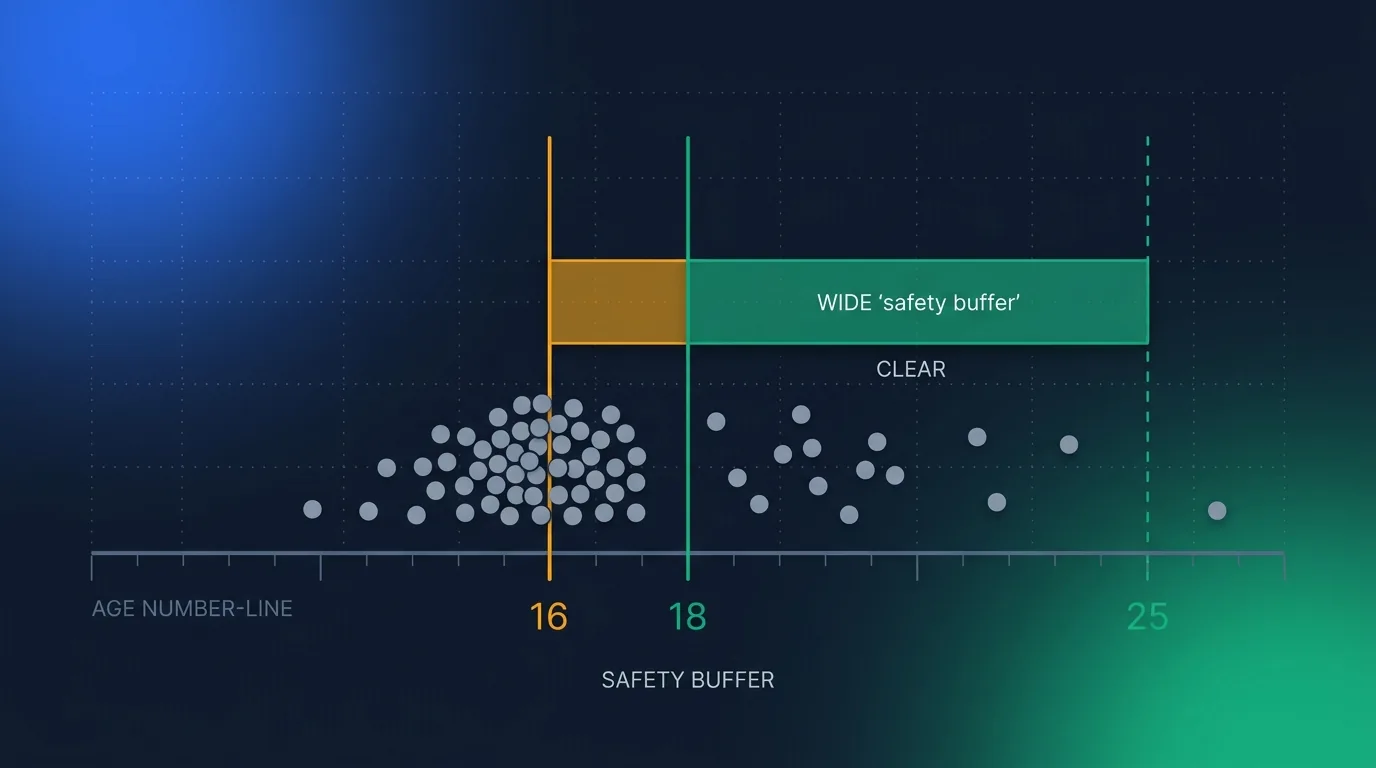
Consider how the 18 line is actually made safe. UK retail has run “Challenge 25” for years: because the legal age to buy alcohol is 18, staff are told to challenge anyone who looks under 25. That is a deliberate seven-year buffer. Age estimation inherits the trick. You do not set your escalation threshold at 18; you set it well above — challenge everyone estimated under 25, pass the clearly-adult tail on estimation alone, and route the buffer zone to a stronger check. A one-to-two-year average error is harmless when your cushion is seven years wide, and the population you drag into escalation is mostly adults who can complete a document-and-liveness step without difficulty.
Now move the legal line to 16 and try to keep the same statistical safety. A proportional buffer would mean challenging everyone estimated under roughly 21 to 23. As the UK Parliament’s science advisers put it, even a one-to-two-year average error means “a 16-year-old could be mistaken for 18” (POST) — so a thin buffer at 16 lets exactly the wrong people through. But a buffer wide enough to be safe now swallows the entire teenage and young-adult population. The band you must escalate is no longer a self-selecting minority at the edge of the distribution; it is the dense middle of it, and it contains the precise ages — 14, 15, 16, 17 — that the law exists to distinguish.
That is the crux. The buffer is a luxury of gating adults. At 18 you can afford a wide cushion because almost nobody caught in it is who you are protecting. At 16 the cushion lands on top of the protected population, so you cannot buy safety by widening it — you can only buy an escalation flood.
The failure surface is symmetric, and it sits on the regulated population
Once estimation cannot settle the case with a buffer, you are back to a threshold decision at the worst possible location, and both errors are costly.
Set the bar to be conservative — treat anyone in the wide teenage band as under 16 — and you lock lawful 16- and 17-year-olds out of services they are explicitly permitted to use, and you sweep in adults in their early twenties for good measure. That is the adult-lockout failure mode migrated onto a younger, larger band, and it is not a rounding error. Under most of these regimes a wrongly excluded user is entitled to an appeal and a correction path, so false positives are an operational cost, not a quiet one.
Set the bar to be permissive — wave through anyone who might plausibly be 16 — and you are admitting 14- and 15-year-olds in direct violation of the ban, with the regulator as your counterparty. At the 18 line the population straddling your threshold is thin. At the 16 line it is the fattest part of the curve. The same decision rule that produced a manageable error volume for adult-content gating produces an unmanageable one here, because the ambiguous zone has moved from the tail to the center.
New York already anticipated this by turning “reasonable” into a measurable spec sheet — accuracy minimums, annual testing, an audit trail. Ofcom’s promised October assessment of “highly effective for over-16” is the same instinct: regulators are converging on the view that the 16 determination needs its own, stricter standard, precisely because the 18 standard does not carry the weight.
The escalation path is the part that actually breaks
Even if you accept a large escalation band at 16, the escalation itself is where the 18 playbook collapses, and this is the point most roadmaps miss.
At 18, escalation means document-plus-liveness or a trusted signal, and it works because the people you escalate are adults who possess government ID and can complete a scan. At 16, the population you escalate is minors and near-minors. A large share of 14-to-16-year-olds do not hold a passport or a driver’s licence at all, so “upload your ID” does not fail gracefully — it fails categorically for the exact users you are trying to classify. Worse, several of the regimes driving this wave forbid an ID-only design: Australia’s law requires reasonable steps without compelling government identification, and California’s proposed rules go further and prohibit requiring government ID or using it as the sole method. You cannot lean on the strong check that rescued the 18 line, because your escalation population can’t produce it and, in places, the law won’t let you demand it.
That forces the escalation tier to be built from methods that were optional at 18 and are load-bearing at 16:
- Verifiable parental consent as a first-class rail, not an afterthought — the mechanism that lawfully resolves an under-16 user rather than merely excluding them. This is the VPC implementation problem, and at the 16 line it moves from edge case to core flow.
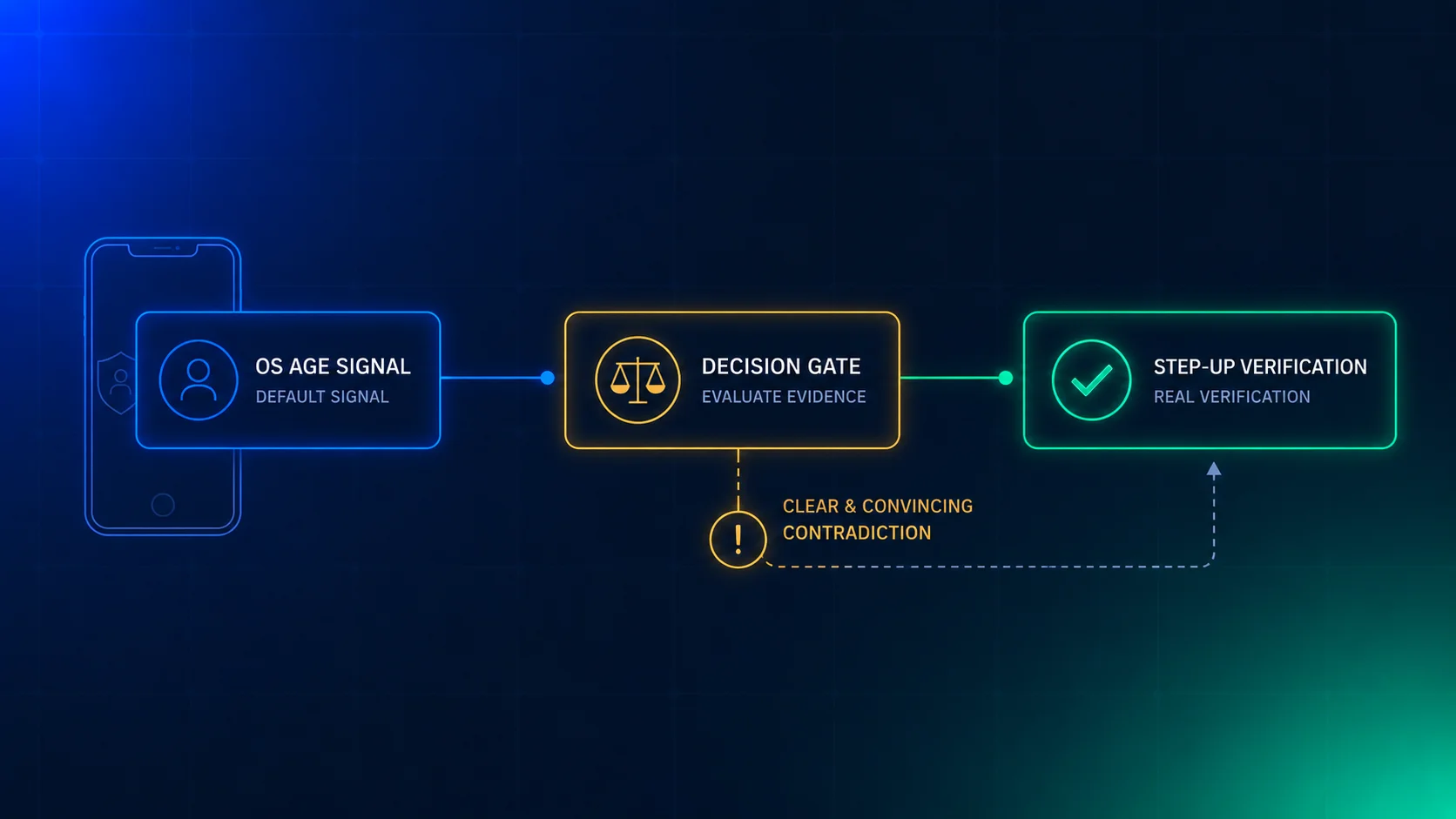
- Device- and OS-level age signals, where a parent-configured child account or a platform-declared age range can corroborate an estimate — useful as a signal, provided you remember these are declarations, not proof, exactly as we argued in OS age signals are not verification.
- Document-and-liveness only where the user has a credential and the jurisdiction permits it — a narrower, not a default, tier.
The design shifts from “estimate, then escalate a thin band to a document check” to “estimate, then route a fat band to whichever lawful, ID-optional method fits this user and this jurisdiction.” That is an orchestration problem, not a single-vendor one.
The architecture that survives the harder threshold
The good news is that nothing here demands a new category of technology. It demands that the layered model be built to move its own threshold and to carry a much heavier escalation tier. Four properties separate a design that survives the 16 line from one that was quietly overfit to 18.
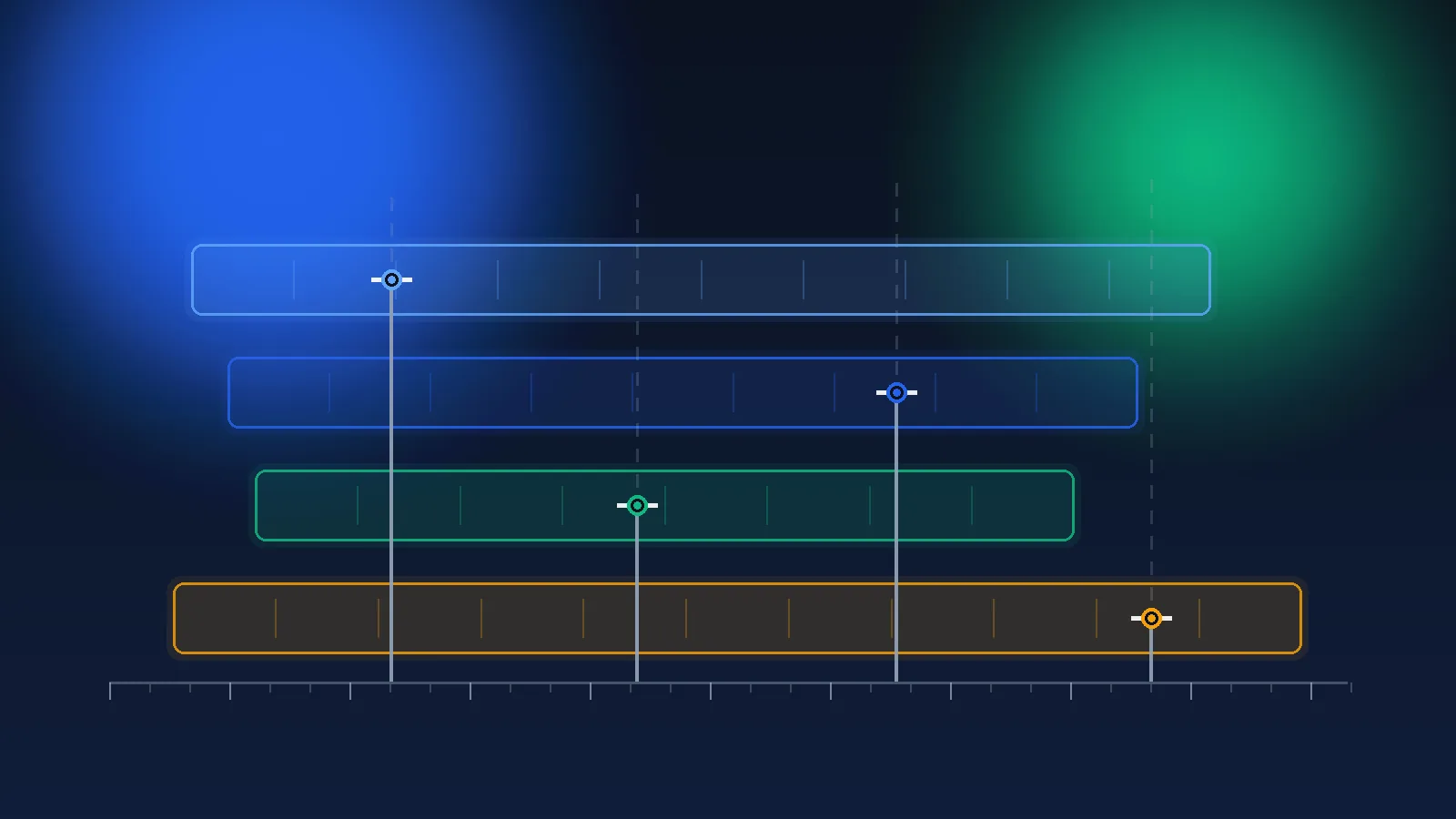
The threshold is configuration, not a constant. You are not asking “is this user 18+”; you are asking “is this user over 16,” or 15, or 13, depending on the jurisdiction. The estimator, the buffer, the escalation band, and the pass/fail logic all have to be tunable per rule, because the line genuinely moves — 16 in the UK, Australia, and Malaysia; 15 in France; 13 for a great deal of US COPPA-adjacent logic. Hard-code 18 and you rebuild for every statute.
The escalation band is expected to be large, and priced accordingly. Treat the teenage buffer zone as the main event, not the exception. That means the escalation methods have to be low-friction, ID-optional, and privacy-preserving by default, because you are routing minors through them at volume. A step-up flow that assumes an adult with a wallet full of ID is not a step-up flow for this problem.
Resolved users are not re-interrogated. A lawful 16- or 17-year-old who has cleared the check should prove it once and re-present a minimal, privacy-preserving attestation on return, rather than run the gauntlet on every session. This is the case for reusable age credentials and zero-knowledge age proofs — prove the fact, discard the identity — and it matters more at 16 than at 18 because the friction you are avoiding lands on children and their parents.
Everything is instrumented against the right line. “Measurable and testable” is now a regulatory phrase, and the accuracy number that matters is not error at 18 — it is your false-positive and false-negative rate at the specific age boundary you are enforcing. If you cannot state your accuracy at 16, you cannot defend your determination at 16, and Ofcom’s October standard will be written in exactly those terms.
This is arriving on a schedule
The reason to treat this as a now-problem rather than a next-year problem is that the deadlines are already set. Australia is live and removing accounts. France enforces in September 2026. Malaysia is enforcing today. Ofcom will hand Parliament its over-16 standard by October 2026, and the UK’s own under-16 restrictions are being built on the assumption that the technology to support them can be specified. The window to design a 16-capable architecture — rather than bolt one onto an 18-gate after the standard lands — is measured in months.
The teams that will struggle are the ones that read the July report as permission to stop. Estimation cleared the 18 line, so the 18-gate config gets copied to the 16 requirement, the escalation band overflows, lawful teenagers get locked out or under-16s get waved through, and the appeal queue and the regulator arrive together. The teams that will not struggle are the ones that already treat the age threshold as a parameter and the escalation tier as the hard part.
What to build before the standard lands
Xident is built for the shape this problem actually has. Age-threshold classification runs estimation-first and low-friction to resolve the clear-adult and clear-child tails, and it is configured against the line you need — 16, 15, or 13 — not a hard-coded 18. The ambiguous teenage band routes into an escalation tier that does not depend on a driver’s licence: verifiable parental consent, corroborating device and OS signals, and document-plus-liveness reserved for the users who have a credential and the jurisdictions that permit it. Returning-user verification means a resolved 16- or 17-year-old re-presents a minimal token instead of repeating the check, satisfying data minimisation and keeping friction off the very users regulators are most protective of. And because the determination is measured against the actual boundary, you can produce the accuracy evidence the coming over-16 standard will demand.
If your compliance surface includes a social platform and your roadmap assumed the 18-gate would stretch to cover an under-16 ban, the Ofcom report is telling you it will not. The line at 16 removes the buffer that made estimation easy, moves the hard cases into the middle of your population, and forbids the strong check you were counting on to rescue them. That is the architecture conversation to have now, while the standard is still being written rather than enforced.
This article is for general information and does not constitute legal advice. Ofcom’s report on the use of age assurance and its forthcoming over-16 assessment were current as described at publication and remain subject to revision, and the age-assurance requirements of the UK, Australian, French, and Malaysian regimes referenced here continue to evolve. Validate your compliance approach with qualified counsel in each jurisdiction against the applicable rules in force.