For three years, the question every product team asked about age verification was a content question: do we host pornography, gambling, alcohol sales, or something a state has labeled “harmful to minors”? If the answer was no, most teams filed age assurance under “not our problem” and moved on. That instinct is now wrong, and the reason it’s wrong is worth understanding precisely, because the mistake is quiet. Nothing about your content changed. What changed is that regulators stopped keying the obligation on what you publish and started keying it on what your users can do to each other.
The new trigger is contact. If your product lets users send text messages, talk over voice, or slide into a DM, a rapidly growing list of 2026 laws and platform policies now treats that capability — not your content library — as the thing that pulls you into age assurance scope. A puzzle game with a chat box is in. A fitness app with community messaging is in. A marketplace with buyer-seller DMs is in. The chat box is the tripwire.
Why the trigger moved from content to contact
The content-based model made sense for the first generation of age laws because it targeted a content-based harm. Pornography is unsafe for minors wherever it appears, so a binary gate at the door of an adult site is the right shape. That’s the logic the US Supreme Court blessed in mid-2025 when it upheld Texas’s adult-site verification statute under intermediate scrutiny, and it’s the logic behind the one-third “harmful to minors” thresholds that dozens of state laws copy.
But the dominant harm regulators are chasing in 2026 isn’t content a platform publishes. It’s contact between users — grooming, coercion, sextortion, and the steady traffic of adults reaching children in game chat, voice channels, and private messages. A content gate does nothing about this. It can confirm a service has both adults and minors and then wave them into the same undifferentiated communication pool. So legislators did the obvious thing: they moved the trigger to the feature where the harm actually lives. The presence of a live communication feature is now, in several regimes, sufficient on its own to create an age-assurance duty — regardless of how wholesome the surrounding product is.
This is the same shift we described in age-based experiences, viewed from the other end. That piece was about what you build once you know who your users are. This one is about the prior question almost everyone is getting wrong: whether the law now says you have to know at all.
The laws and policies that key on communication
Four distinct forces are converging on the same trigger, and they arrive through different doors, which is exactly why teams miss them.
Purpose-built “online predator” bills. New York’s Stop Online Predators Act (S4609/A6549) is the clearest statement of the new model. Rather than target content, it targets any online platform with live text messaging or voice chat, and requires a commercially reasonable form of age assurance plus open chat functions turned off by default for minors unless a parent switches them on. The named examples in the legislative discussion aren’t adult sites — they’re Steam, Roblox, Discord, Facebook, and Snapchat. The bill is still moving rather than enacted, but it codifies a template other states are already drafting against.
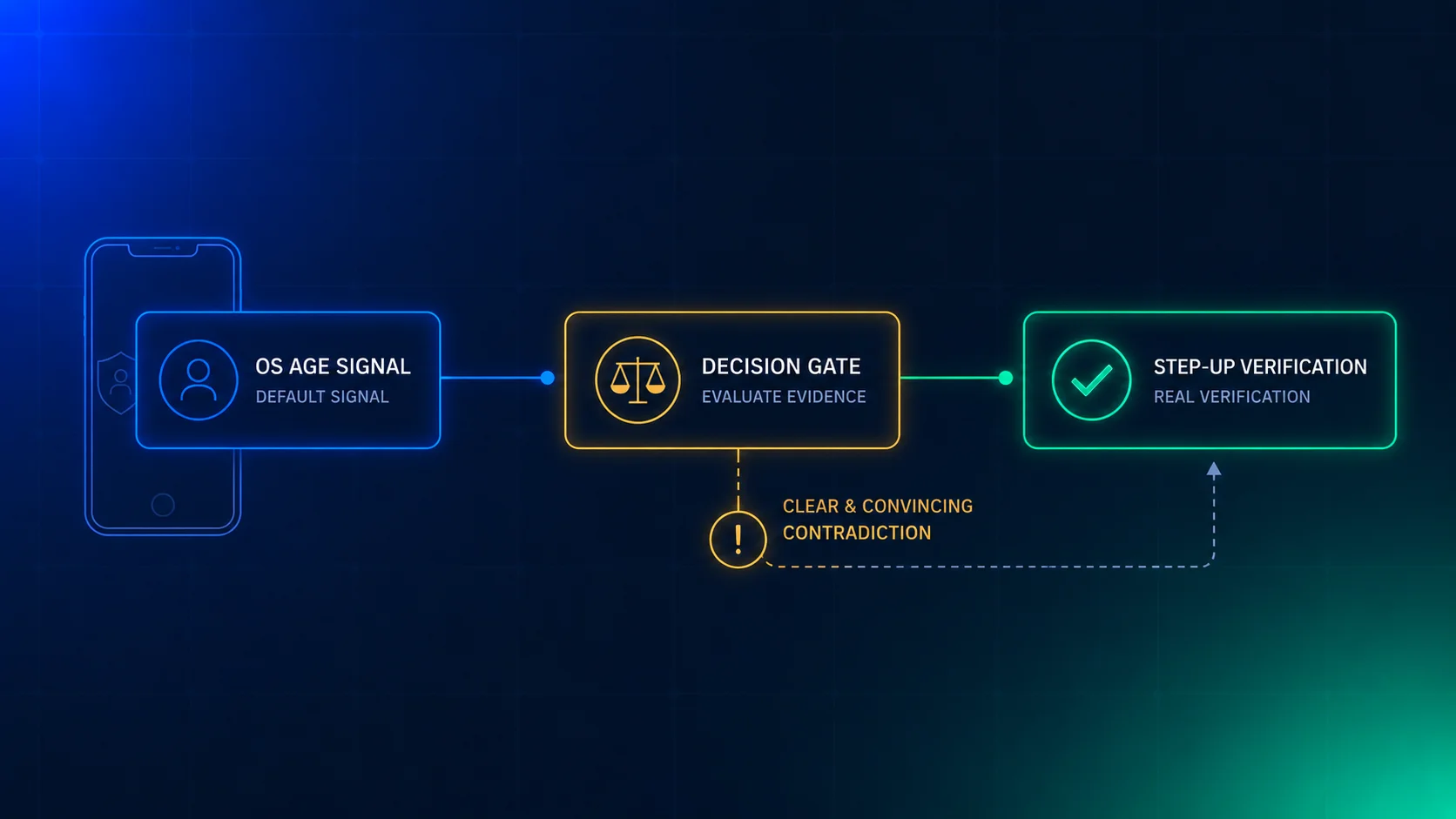
App store accountability acts, one layer down. The state App Store Accountability Acts now in force — Texas SB 2420 among them — push an age category down from the store to the developer and require the developer to act on it. The moment your app introduces a social chat feature, the category you receive stops being informational and becomes a gating input: a minor category may mean you must obtain parental consent or restrict messaging before enabling it. A developer who ships a chat update without wiring the age signal into that feature has quietly fallen out of compliance without touching a line of content policy.
COPPA’s expanded surface. The 2026 COPPA amendments broaden what counts as covered personal information and tighten obligations around services directed to or knowingly used by children. Persistent identifiers and communication metadata now sit more squarely inside the definition, and enforcement dates through late 2026 give the FTC a sharper instrument. For any general-audience service with messaging, “we don’t collect much” is a weaker defense than it was a year ago.
Platform policy running ahead of statute. Even where no law yet compels it, the largest platforms have already made contact the trigger, and their choices set the market expectation regulators then ratify. Roblox made every user on Earth complete an age check before using chat in January 2026 — an expensive, instructive rollout. Discord gates access to age-restricted servers behind age assurance that is teen-by-default in the UK and Australia. When the incumbents treat chat as the gate, “everyone else does self-declaration” stops being a safe-harbor argument.
The throughline: none of these keys on your content. All of them key on whether users can reach each other.
How to tell whether you’re in scope
The self-assessment is simpler than the legal text and more uncomfortable than most teams expect. Walk your product and ask three questions.
First, can any two users exchange a message? Text chat, voice, video, DMs, comment replies that notify, ephemeral messages, even “reactions” that carry free text — if user A can put content in front of user B whom they didn’t previously know, you have a contact surface. Support-style messaging between a user and your own staff does not count; user-to-user does.
Second, can an adult reach a minor through that surface? If your user base plausibly includes both — and for any general-audience app it does, whatever your terms of service pretend — then the grooming risk regulators are legislating against exists on your platform by construction. “We’re not for kids” in a ToS you don’t enforce is precisely the posture the Reddit ICO fine and the COPPA “actual knowledge” standard are designed to defeat.
Third, does the surface default open? A feature that is contactable by strangers out of the box is the specific configuration these laws target. The remedy they prescribe is nearly always the same: default the contact surface closed for minors and require assured age to open it. If your messaging is open-by-default and you have no age signal deciding who gets it, you are the fact pattern.
If you answered yes, yes, and open, you are in scope in at least one 2026 regime today, and in more of them by year end. The precise citation varies by jurisdiction; the exposure does not.
The trap: treating this as a content-gate problem
The teams that stumble here are the ones who reach for the wrong architecture. A content gate is a turnstile — one boolean at the door, over-18 or not, computed once and discarded. Bolting that onto a communication product produces the worst of both worlds: it taxes your entire user base with hard verification friction it doesn’t need, and it still doesn’t answer the question the law is actually asking, which is relational — not “is this user an adult?” but “given who these two users are, may they talk?”
Contact-triggered obligations demand a graded age signal, not a pass/fail bit, because the protective rule operates between two people. And they demand that the signal reach the specific feature — the chat toggle, the DM permission, the voice-channel join — rather than sitting uselessly at account creation. A platform that verifies age at signup and then throws away the granularity has, again, discarded the one input every downstream rule depends on.
The friction math also breaks if you gate hard at the door. Most of your users are doing nothing more sensitive than chatting, and hard verification on all of them is where your funnel goes to die — the drop-off problem is real and it is large. The architecture that survives is the two-tier one we build Xident around.
What contact-triggered age assurance should look like
The defensible shape is a waterfall, applied to the feature rather than the door.
Resolve the majority with a low-friction Check. When a user reaches for a communication feature, run a measured age Check — facial age estimation for a confident age-range read, a returning-user credential lookup for someone who has verified before, a liveness or authenticated-device signal, an open-banking or wallet handoff. This is cheap, fast, and produces an auditable age band, not a face on file. Most users clear here and get their chat.
Reserve full Verification for the contested edge. When the measured Check lands near the boundary that matters — and the under-16 line is the hard case because estimation error brackets it — escalate to a document or NFC chip-read Verification with selective disclosure. High assurance is expensive, so you spend it only on the minority the cheaper tier couldn’t resolve, never on your whole population.
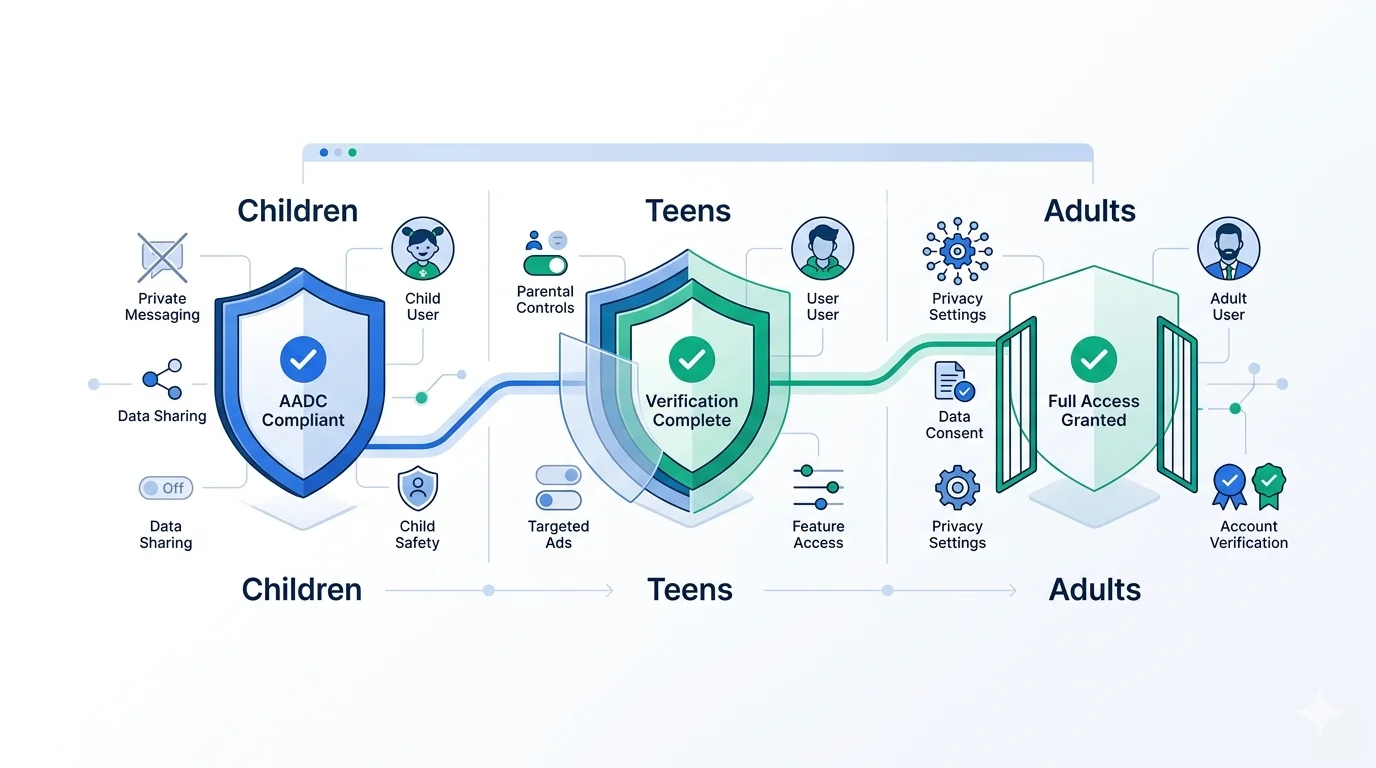
Default the surface closed for minors, and let the band open it. This is the compliance core of the new laws expressed as product behavior: an assured-adult band gets open contact; a minor band gets contact restricted to its own tier and below, or held closed pending parental consent where the statute requires it. The age signal isn’t a gate of record you file away — it’s the live input to who can message whom.
Keep the assertion, not the evidence. What your systems store is a signed “this user is over 16” (or the band), not the scan or the ID behind it. On a communication platform this matters double: you are already a magnet for the data-retention breach wave, and the last thing you want is a verification honeypot bolted to a messaging product. Retain the claim; discard the proof.
Layer a reusable credential across the flow and a user who clears the Check once can unlock contact features here and elsewhere without repeating anything. Verify once, prove everywhere — and the per-feature friction becomes a one-time cost.
Five moves to make before your next chat release
- Inventory every contact surface. Map every place one user can reach another — chat, voice, DMs, comments, invites, free-text reactions. That inventory is your scope map. Most teams find more surfaces than they expected.
- Decide, per surface, what an assured minor is allowed to do. Closed by default, tiered contact, or parental-consent-gated. This is a product-and-policy decision the verification layer cannot make for you.
- Wire the age band into the feature, not just the account. If your age signal stops at signup, it is not doing the job the law requires. It has to reach the chat toggle.
- Choose a two-tier flow, not a single hard gate. Measured Check for the majority, Verification for the contested edge, so the friction lands only where assurance is genuinely needed.
- Treat platform policy as a leading indicator. Where Roblox and Discord have already put contact behind age assurance, the statute that makes it mandatory is usually a session or two behind. Build for the trajectory, not just the current line.
The real headline
The age-verification map most teams carry in their heads is a content map: adult sites in, everyone else out. That map is now out of date. The 2026 laws and the platforms leading them have redrawn the boundary around a different feature entirely — the one that lets your users talk to each other. If you shipped a chat box thinking age assurance was someone else’s compliance problem, the honest read of the current trajectory is that it became yours the moment two strangers could message on your platform.
The good news is that the architecture is known and the friction is manageable if you build it correctly. Resolve the majority with a measured Check, reserve Verification for the contested few, default the contact surface closed for minors, and keep the assertion instead of the evidence. Do that and the chat box stops being a liability and becomes what regulators actually want it to be: a place where you know enough about who’s talking to keep the wrong conversations from starting.
Xident provides privacy-first age assurance built on a two-tier model: a low-friction, measured Check for the confident majority — facial age estimation, returning-user credential lookup, liveness, and OAuth — and a high-assurance Verification for the contested few, returning a signed age assertion rather than retaining the underlying identity document. If your product has chat, voice, or DMs and you’re not sure whether the new contact-triggered laws pull you into scope, see how the two operations work or talk to us.