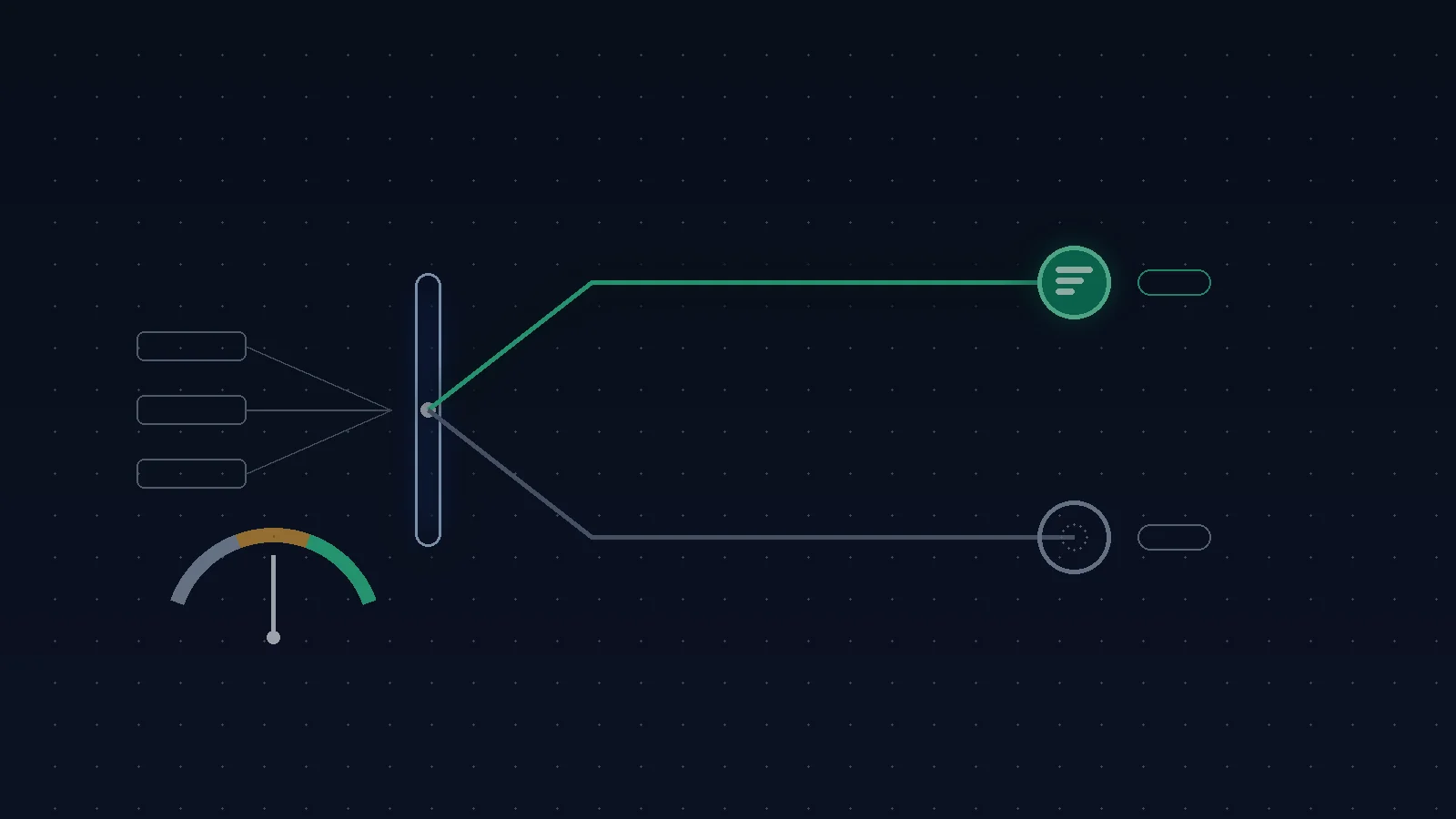
On August 13, 2026, YouTube began doing something no platform of its size had done before: guessing how old you are, silently, from how you behave. The company’s US rollout of AI age estimation does not ask most users to upload anything. It reads signals a logged-in account already emits — the categories of videos watched, search patterns, how long the account has existed — and classifies the account as likely over or likely under 18. Accounts estimated to be minors get teen protections switched on automatically: personalized ads off, certain content repetition limited, digital-wellbeing nudges enabled (Time, ID Tech Wire).
Set aside the privacy debate for a moment, because the strategic signal is bigger than YouTube. The largest general-audience platform on the planet has decided that the front door to age assurance is estimation, not verification. It has decided that asking a billion people to prove their age up front is the wrong default, and that inferring age from what the system already sees — then escalating only the contested cases — is the right one. That is not a YouTube-specific product choice. It is the architecture the rest of the internet is about to converge on, and most teams building toward it are getting the hard part backwards.
The hard part is not the estimator. It is the handoff.
What YouTube is actually doing — and what it is not
Two words matter and they are not interchangeable: estimation and verification. Estimation produces a probability that an account belongs to someone above or below a threshold. Verification produces a bound assertion — this credential says this person is 18, and here is the cryptographic or documentary evidence. YouTube’s front door is pure estimation. It never sees an ID for the overwhelming majority of accounts.
It is also worth being precise about which estimation. The public conversation collapses “AI age estimation” into facial age estimation — the two-second selfie video that infers age from facial geometry. YouTube is not doing that at the front door. It is doing behavioral estimation: inference from engagement history. Those are different techniques with different failure modes. Facial estimation fails on people whose faces sit near the threshold and on demographic groups where training data is thin. Behavioral estimation fails on anyone whose viewing habits do not match the model’s idea of their age cohort — the 40-year-old who only watches gaming and animation, the shared family account, the newly created adult account with no history to read.
The reason YouTube can lead with the weaker, lower-friction signal is the same reason retailers lead with a glance instead of an ID check: for the protections it is applying, the cost of a wrong guess is low and reversible. Turning off personalized ads for an adult is an annoyance, not a lockout. That tolerance is what makes estimation-first economical at planetary scale. The instant the consequence of a wrong guess becomes “you are blocked from the service” or “you are exposed to content a regulator will fine us for,” the calculus inverts — and that is exactly the situation most of the platforms watching YouTube are actually in.
Why estimation-first is the right default anyway
Estimation-first is not a YouTube gimmick. It is the direction independent evidence and regulators have both been pointing for a year.
Ofcom’s first statutory age-assurance report, published July 16, 2026, recorded more than 69 million age checks across a sample of 32 regulated UK services in the second half of 2025 — a 23-fold jump — with facial age estimation the method 8-to-17-year-olds recalled encountering most often. The Australian Age Assurance Technology Trial reached a similar practical conclusion: the workable pattern is successive validation — start every user on the lowest-friction check that could plausibly resolve them, and escalate to a heavier check only when the light one is not confident (Biometric Update).
The logic is friction economics. Every additional step in an age gate costs you real users — a document upload flow sheds a meaningful fraction of legitimate customers at the exact moment you are trying to onboard them. If you can clear 80–95% of your population with a check that takes two seconds and no document, you reserve the expensive, high-abandonment path for the minority the cheap path could not resolve. A document-and-face-match verification is roughly an order of magnitude more expensive to run than a lightweight check, and it is far more expensive in conversion. Spending it on everyone is the mistake estimation-first exists to avoid.
So the default is settled. Estimation goes first. The differentiator — the thing that separates a stack that works from one that generates support tickets and regulatory exposure — is what happens to the accounts estimation cannot resolve.
The part everyone underbuilds: the appeal
Here is YouTube’s own escape hatch. If the system wrongly estimates you as under 18, you can prove you are an adult with a credit card, a government ID, or a selfie (Time). Read that sentence as an architecture spec, because a huge number of platforms are about to copy it verbatim, and two of those three options are traps.
A credit card is not proof of age. It is proof that a payment instrument was issued to someone, and teenagers hold authorized-user and prepaid cards routinely. Treating a successful card check as an age assertion is a control that looks rigorous in a compliance deck and fails the moment a regulator or a plaintiff’s lawyer asks what it actually verifies. We have written about this specific failure mode before; it does not get less true because YouTube offers it as an option.
Government-ID upload is the honest fallback, but it inherits its own crisis. AI-generated identity documents now cost a few dollars and pass a large share of document-upload-plus-selfie stacks on the first attempt. If your step-up path is a naive photo-of-ID flow, you have escalated your uncertain users straight into the synthetic-ID problem — you spent friction to buy fraud. The step-up has to be a real verification: NFC chip reads that are cryptographically signed by the issuer, or a mobile driver’s licence with selective disclosure, not a JPEG a generator can fabricate.
And then there is the demographic that the appeal path punishes hardest: adults the estimator got wrong. Behavioral and facial estimation both concentrate their errors near the boundary and on under-represented groups. The people forced into your step-up are disproportionately the ones for whom the light check failed — which means your appeal flow is not an edge case you can neglect, it is the concentrated experience of your most-likely-to-be-frustrated legitimate users. If proving you are an adult is slow, invasive, or dead-ends, you have not built an age gate. You have built an adult-lockout machine with a friendly estimator bolted to the front.
The appeal is not the safety net under the product. On an estimation-first stack, the appeal is the product’s assurance. Design it first.
The data you keep is the liability you keep
There is a second reason estimation-first has to be built deliberately rather than bolted on, and it is the part that turns a product decision into a board-level risk.
Behavioral age estimation runs on a profile — a record of what an account watched and searched, retained and modeled well enough to output an age. Facial estimation runs on a biometric. Both are exactly the categories of data that regulators treat as sensitive and that breach headlines are made of. 2025 and 2026 have already delivered a run of incidents where the age-verification layer itself became the breach surface, because a vendor or platform stored the identity artifacts it collected to prove someone’s age. The uncomfortable truth of estimation-first is that the front door, done carelessly, builds a behavioral dossier on every user, and the step-up door, done carelessly, builds an ID vault.
The way out is the same principle on both doors: minimize what you retain to the assertion, not the evidence. You need to be able to prove that an account cleared an age check and when — an auditable event a regulator can inspect. You almost never need to keep the selfie, the document image, or the raw behavioral trace that produced the decision. On-device estimation, where the model runs on the user’s phone and only the boolean result leaves it, collapses most of this exposure. A verification that returns a signed “over-18” token and discards the underlying document does the same for the step-up. If your architecture cannot answer the question “what would an attacker get if they breached this tomorrow” with “a log of pass/fail decisions,” you are carrying risk you did not need to carry to run the check.
What this means for your stack
Translate all of this into an actual build and it is a short list, in a deliberate order.
Lead with the cheapest resolving check. For a returning user, that is a lookup — has this person already been assured, and can they present a reusable, cryptographically bound credential instead of starting over? Reusable age credentials are the highest-leverage friction reduction available, because the cheapest verification is the one you never have to repeat. For a new user, lead with estimation or a lightweight check — a two-second signal, ideally on-device — and let it clear the large majority who are comfortably away from the threshold.
Escalate only the uncertain band, and escalate to something real. The users the light check cannot confidently place get a genuine step-up: a chip-verified document or an mDL with selective disclosure, not a credit card and not a raw photo upload. This is the layered waterfall that the successive-validation model describes, and its whole economic argument is that the expensive path only ever runs on the minority who need it.
Treat the appeal as a first-class flow, instrument its false-positive rate, and watch it by demographic — because that number is where your fairness problem and your abandonment problem both live. And retain the decision, not the evidence.
This is precisely the split Xident is built around. A Check — a browser-based age check, on-device liveness, a returning-user lookup, an OAuth handoff — is the low-friction front door that resolves most of your traffic cheaply. A Verification — document read plus face match — is the higher-assurance step-up you reserve for the contested band. Keeping those two as distinct, priced-differently operations is not an accounting detail; it is the architecture that lets you run estimation-first without either bankrupting conversion or under-verifying the users who actually matter. And because the assurance can be issued as a reusable credential, the second platform a user meets does not have to pay for the check the first one already ran.
The takeaway
YouTube did not invent estimation-first age assurance. What it did was normalize it, top-down, for an audience the size of the internet — and in doing so it made the model unavoidable for everyone downstream. Within a few quarters, “we estimate first and verify only when we have to” will read as table stakes rather than innovation, the way SMS-based verification once did.
But normalization is not the same as competence. The estimator is now a commodity; a dozen vendors will sell you one. The stack that wins is the one that treats the estimator as the easy 90% and pours its engineering into the other 10% — the step-up that resists synthetic documents, the appeal that does not humiliate the adults it wrongly flagged, and the retention discipline that keeps the whole apparatus from becoming next year’s breach disclosure. YouTube just told the entire market where the front door is. The lock is still yours to build.
Building an estimation-first age gate and trying to get the verification handoff right? Talk to Xident — a low-friction Check up front, a chip-grade Verification for the step-up, and a reusable credential so nobody pays twice.