For most of the age-verification wave, audio felt exempt. The laws were written for things you look at — pornography, violent video, gambling reels, social feeds full of images. A song is not an image. A podcast is a voice in your ear while you drive, cook, or fall asleep. The whole point of the medium is that you are not staring at a screen. So streaming teams filed age assurance under “not our problem” and kept shipping.
That instinct is now wrong, and the way it broke is instructive. In August 2025 Spotify partnered with Yoti to run age checks on 18+ content for UK users, starting with explicit music videos and expanding to content flagged mature — including podcasts. Miss the check and playback pauses. Over the following year, users in the US, Canada, Australia, New Zealand, and several EU markets started seeing the same prompt. The most personal, most screen-free medium on the internet now stops mid-track and asks you to look into your phone’s front camera.
This is not a Spotify story. It is a scoping story, and it lands on every product with a catalog of audio and a checkbox somewhere that says “explicit.” If you run a music service, a podcast host, an audiobook platform, or any app where users press play, the question is no longer whether age assurance applies to you. It is how you gate a fraction of your catalog without breaking the ninety-plus percent that is perfectly fine — and without turning a hands-free medium into a face-scanning one.
Why audio got captured
The reason has nothing to do with audio being newly dangerous and everything to do with how the 2026 laws define scope. The first generation of age laws was content-specific: a site is an adult site, so it verifies at the door. But the UK Online Safety Act and the regimes modeled on it do not ask “are you an adult platform.” They ask a narrower, more dangerous question: does your service let a child reach content that is harmful to them? If any meaningful slice of your catalog is 18+, the duty attaches to your whole service — not to the slice.
That is the same logic we unpacked in the one-third rule and again when the SCREEN Act deleted the content threshold entirely. A general-audience platform used to scope itself out by measuring its own content mix and finding it nowhere near the line. Audio platforms are the purest example of a general-audience service getting caught anyway: a music catalog is overwhelmingly clean, but it contains explicit tracks; a podcast directory is mostly conversation, but it contains true-crime, sexual-health, and adult-comedy shows. The clean majority does not buy you an exemption. The explicit minority sets the duty.
Layered on top is Ofcom’s “highly effective age assurance” standard, which self-declared birthdays cannot meet. The regulator has already shown it will price the gap: the ICO’s £14.5m fine against Reddit in early 2026 — self-declaration was not enough — put a number on relying on an honor system. Ofcom’s list of methods that can be highly effective is short and specific: open banking, photo-ID matching, facial age estimation, mobile-network-operator checks, credit-card checks, digital identity services, and email-based age estimation. Facial age estimation made the list because, done right, it estimates an age band without identifying the person — which is also why Ofcom and the ICO, in their March 2026 joint statement, treat it as generally not special-category biometric data. That distinction is the entire reason a music app can deploy a face scan at all without becoming a biometric-surveillance product.
The net effect: audio is in scope, the acceptable methods are known, and the honor system is off the table. What is left is a hard product problem.
The verification problems unique to audio
Audio is not video with the picture removed. Its constraints are its own, and most of them make age assurance harder, not easier.
1. The primary use mode has no screen
Video platforms can assume a user looking at a display. Audio cannot. The defining audio contexts — driving with CarPlay, running with the phone strapped to an arm, cooking with the screen dark, drifting off with earbuds in — are exactly the moments when a “hold your face up to the camera” prompt is impossible or dangerous. A verification flow that assumes an attentive, screen-facing user will fail the majority of real listening sessions. The gate has to be established before the hands-free session begins, or it has to fail gracefully into “come back to a screen to unlock this.”
2. Catalog-level gating causes mid-playback pauses
A streaming catalog is tens of millions of tracks and episodes, a small fraction flagged explicit. If you gate at the item level — checking age the instant a user hits an 18+ song in a shuffle — you interrupt playback constantly, and each interruption lands mid-experience, which is the worst possible moment to demand friction. The alternative is to resolve an age tier once at the session or account level and let playback flow, gating the explicit subset silently against the already-known tier. Verify-once beats verify-per-track by an enormous margin here.
3. The “explicit” tag is unreliable metadata
Scoping depends on knowing which content is 18+, and in audio that signal is supplied by rightsholders and creators, not the platform. Music has a reasonably consistent explicit flag; podcasts have almost none. A podcast host inherits whatever the publisher declared in an RSS feed — and true-crime, sexual-health, and adult shows are routinely unlabeled. Before you can gate accurately you often have to classify accurately, which means the age-assurance problem quietly includes a content-labeling problem you did not think you had.
4. Shared accounts and family plans blur who is listening
Family and Duo plans, shared devices, and a single household login are the norm in audio, not the exception. Verifying “the account holder” is an adult tells you little about who has the earbuds in right now. Age assurance for audio has to reason about the listener, not just the subscriber — which pushes you toward per-profile age tiers and lightweight re-assurance when a session’s behavior suggests a different user, without turning every playback into an interrogation.
5. Cross-surface continuity — including headless devices
A single user streams across phone, laptop, car head unit, TV, game console, and smart speaker. Some of those surfaces have a camera and a keyboard. A Sonos speaker, an Echo, a car dashboard does not. You cannot run a face scan or an ID capture on a device with no camera and no screen — yet those headless surfaces still need to honor the same age gate. The only workable pattern is to bind a verification performed on a capable device (the phone) to the headless one, so the speaker inherits a tier it could never establish on its own. This is the audio-specific version of the reusable-credential problem: verify once on a surface that can, prove everywhere including surfaces that can’t.
Building compliant age assurance for audio
The architecture that survives these constraints looks less like a checkpoint and more like a tier that follows the listener across devices. Four principles.
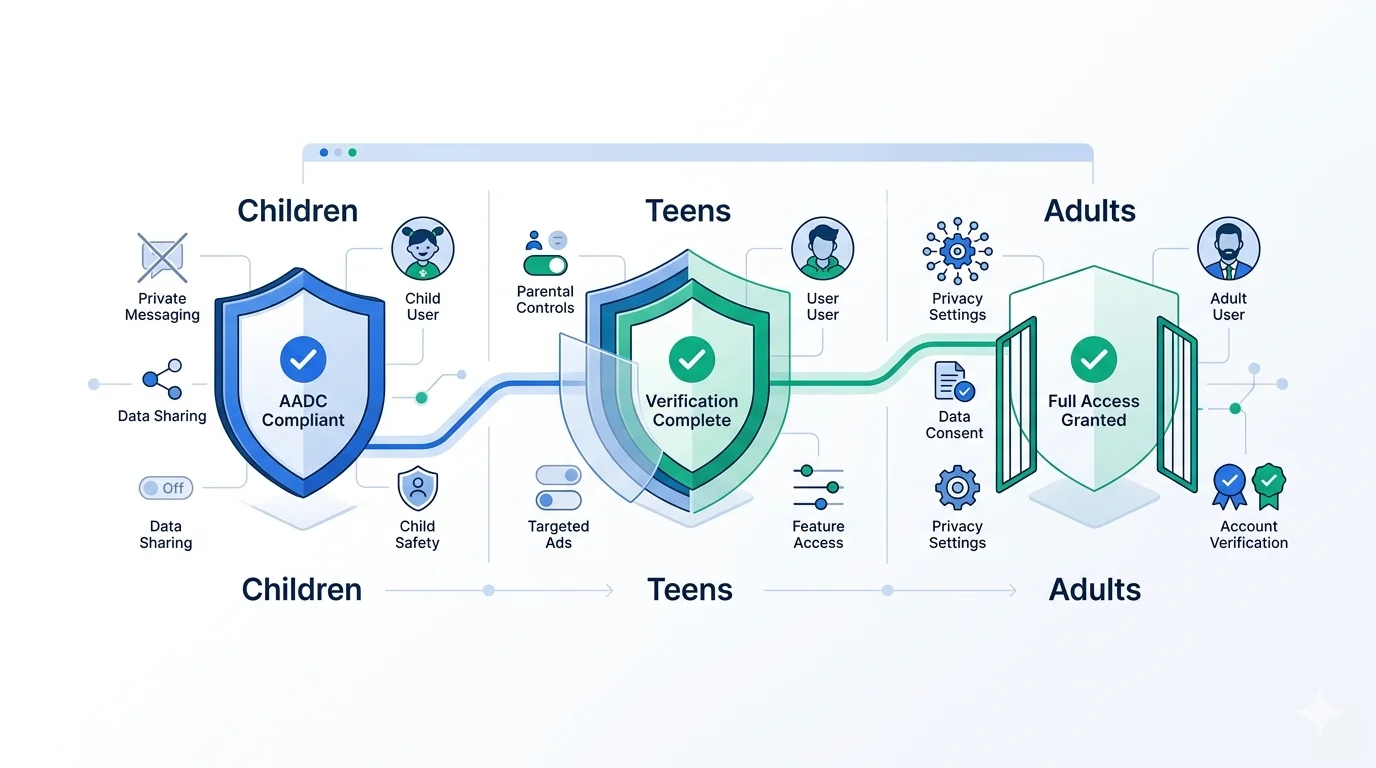
Establish an age tier, not a yes/no gate. Resolve the listener into a band — under 13, 13–15, 16–17, 18+ — once, and attach it to the profile. Explicit tracks, mature podcasts, and any future 21+ content all gate against the same cached tier without re-running verification.
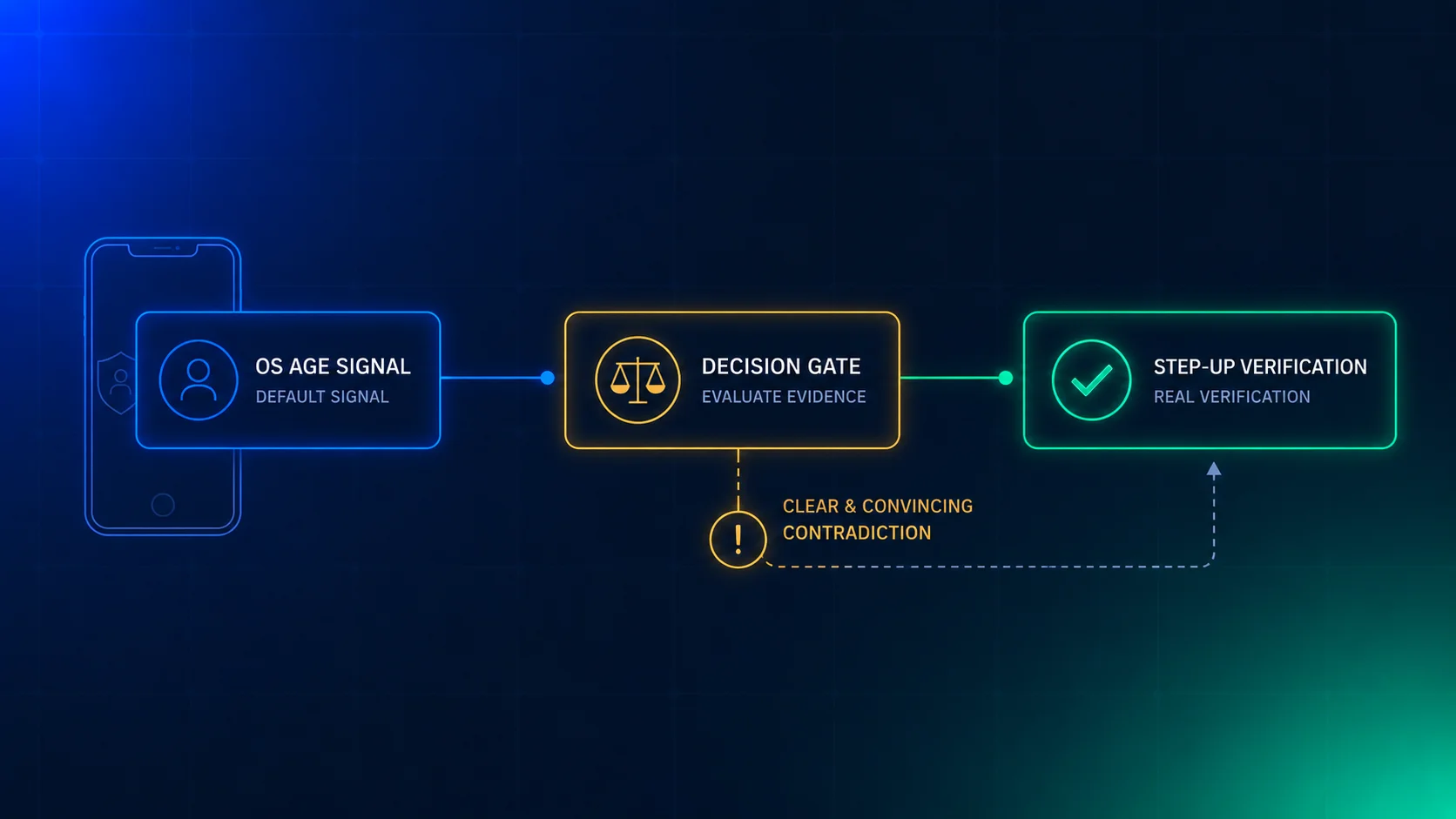
Estimate first, escalate only when needed. Most listeners are unambiguously adults. Run a fast, low-friction age estimation as the first step; only route the ambiguous cases — the ones near the threshold or that fail estimation — into a heavier document check. This estimate-then-verify waterfall is exactly the two-tier flow Spotify itself deploys through Yoti, and it keeps the expensive step rare.
Bind capable devices to headless ones. Do the verification where a camera exists — the companion phone app — and issue a token the speaker, car, and TV can carry. Never try to originate a check on a device that physically cannot perform one.
Retain nothing you don’t need. Estimation should return an age band and discard the image. Given the breach wave that punished platforms for hoarding verification data, the privacy-first posture — process, decide, delete — is both the compliant choice and the defensible one. Yoti’s own flow for Spotify deletes the user’s photo after the check completes; that is the floor, not a differentiator.
Method selection for audio platforms
| Verification need | Recommended method | Completion time | Where it runs |
|---|---|---|---|
| First access to explicit content | Facial age estimation | 3–5 seconds | Phone / laptop (camera) |
| Estimation ambiguous or failed | Document verification (step-up) | 15–45 seconds | Phone / laptop |
| Returning listener | Cached age-tier token | Under 1 second | Any surface |
| Smart speaker / car / TV | Companion-app verification, bound token | Under 1 second (inherited) | Headless device |
| Family-plan sub-profile | Per-profile estimation or parental assignment | 3–5 seconds | Phone / laptop |
| Re-assurance on behavior shift | Passive signals, optional re-estimate | Under 1 second | Active device |
Gating pattern
// Pseudocode: gate explicit audio without pausing clean playback
async function resolvePlayback(profileId, trackId, surface) {
  const tier = await getAgeTier(profileId); // resolved once, cached

  const track = await getTrack(trackId);
  if (!track.explicit) return play(track); // ~90%+ of the catalog

  // Explicit item: gate against the already-known tier — no mid-song check
  if (tier && tier.value >= 18 && !tier.expired) return play(track);

  // No usable tier yet. Behavior depends on the surface.
  if (surfaceHasCamera(surface)) {
    return promptAgeCheck({ method: 'age-estimation', returnTo: trackId });
  }

  // Headless surface (speaker, car, TV): can't verify here.
  return deferToCompanion({
    message: 'Finish this age check in the app to unlock explicit content',
    fallback: playCleanVersionIfAvailable(track),
  });
}
The important move is the first line: the tier is resolved once and cached, so the overwhelming majority of playback — the clean catalog — never touches a verification path, and the explicit subset checks a token rather than a camera.
What the platforms are doing
Spotify is the bellwether. Its Yoti integration runs facial age estimation with an ID-document fallback for content flagged 18+, launched in the UK under Online Safety Act pressure and now surfacing across additional markets. Fail or decline the check and access to that content is restricted while the rest of the service keeps working — a scoped gate, not a front-door wall. Spotify’s public age-assurance page frames it as estimation-first, ID only when estimation is inconclusive.
Apple (Music and Podcasts) leans on the OS. Rather than a per-app face scan, Apple pushes a declared-age-range signal from the account and device layer that apps can consume — part of the broader device-level age-signal approach Apple and Google are building. It is lower friction but weaker assurance, and whether it clears “highly effective” for explicit content is still contested.
YouTube Music inherits Google account age status, including Google’s own estimation and ID/credit-card escalation. The strength is one check across Google’s surfaces; the weakness is the same embedded-everywhere problem the video product has.
Amazon Music and Audible ride the Amazon account and its payment-instrument signals, with Alexa introducing the headless-device problem in its sharpest form — a voice interface with no practical way to run a visual age check on the device itself.
SoundCloud, podcast hosts, and independent audio apps are the exposed middle. They carry explicit content, lack a platform-scale identity layer to lean on, and are increasingly the ones for whom an integrated third-party age-assurance provider is the only realistic path to “highly effective” without building biometrics in-house.
Roadmap for audio platforms
Now (Q3 2026). Audit your catalog’s explicit and mature flags — for podcasts, this is a labeling project before it is a verification project. Deploy estimation-first age assurance for explicit content on camera-capable surfaces. Make sure declining the check restricts only the gated subset, not the whole service.
Near-term (Q4 2026). Resolve age to a cached per-profile tier and bind it across devices so cars, speakers, and TVs inherit rather than re-verify. Stand up the companion-app hand-off for headless surfaces. Prepare to accept the EU age-verification app / mini-wallet credential as pilot countries push it into app stores.
2027. Support portable, reusable age credentials so a listener verified in one app proves age in another without repeating the flow, and fold in OS-level age signals where they clear the regulator’s bar. Watch podcast comment and community features, which can pull a service into communication-feature scope on top of the content-based duty.
How Xident fits
Xident’s two operation types map cleanly onto the estimate-then-verify shape audio demands, which is the same shape the regulators reward and the same one Spotify built:
- Check is the low-friction first step — browser-based age estimation, liveness, and returning-user lookup — fast enough to resolve a listener before a hands-free session starts, and roughly an order of magnitude cheaper than a document scan, so running it on the clean-adult majority does not blow up unit economics.
- Verification is the step-up — document capture with OCR, face match, and NFC chip reading — reserved for the ambiguous cases that estimation cannot clear, exactly where high assurance is worth its cost.
- Returning-user tokens let a listener verified once carry an age tier across phone, car, speaker, and TV without repeating the check — the verify-once-prove-everywhere pattern headless audio surfaces require.
- Client-side liveness runs on-device to block spoofing without shipping biometric images to a server, keeping the flow inside the data-minimising posture Ofcom and the ICO expect.
- One integration, one regulatory surface covers the UK, EU, and US-state patchwork, so a global catalog does not need a different age-assurance stack per market.
For a music or podcast platform, the practical translation is: estimate the whole audience cheaply with Check, escalate the few genuinely uncertain cases to Verification, cache the result as a tier, and let it follow the listener — including onto the devices that could never run the check themselves.
The bottom line
The age gate reaching audio is not a quirk of one platform’s UK compliance. It is the predictable result of laws that scope on the presence of harmful content rather than the character of the service — and a music catalog or podcast directory almost always contains some. The teams that treat this as an item-level checkpoint will spend 2026 pausing songs mid-shuffle and watching churn. The teams that treat it as a per-listener age tier — resolved once, cheaply, and carried across every surface including the ones with no camera — will gate the sliver of content the law cares about and leave the rest of the experience untouched.
Audio was the last screen-free medium. It is not exempt anymore. The design question is no longer whether to verify, but how to do it without making people look at their phones to hear a song.
Building age assurance into a music, podcast, or audiobook platform? Talk to Xident’s team about estimation-first flows and cross-device age tiers, or explore the docs to see how Check and Verification handle explicit-content gating across surfaces.